
















X9 Services SETA Personal Care Qualifications and Industry Applications
Services SETA Personal Care Qualifications and Industry Applications
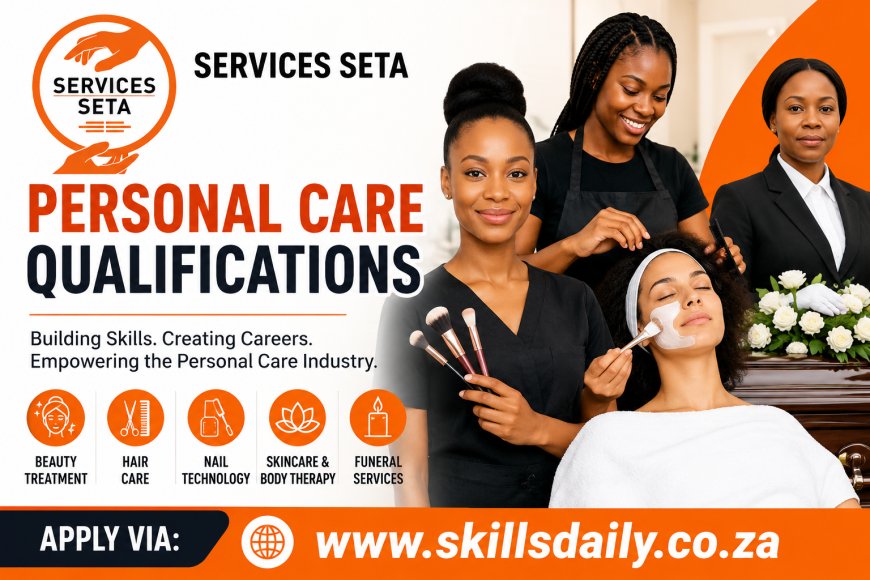
The personal care industry is one of South Africa’s diverse service sectors, creating opportunities for people interested in beauty, hairdressing, skincare, nail technology, funeral services, fashion and related occupations. Through the Services Sector Education and Training Authority (Services SETA), learners can access qualifications and training pathways designed to develop practical skills for employment and entrepreneurship.
According to Services SETA, the Personal Care chamber covers several subsectors, including beauty treatment, hair care, funeral services, fashion and modelling, and image consulting.
What Are Services SETA Personal Care Qualifications?
Services SETA facilitates skills development through programmes such as learnerships, skills programmes, internships and other learning initiatives. Its role includes supporting employers and skills development providers in providing training to employed and unemployed learners.
The Personal Care qualifications are intended to help learners develop knowledge, practical abilities and workplace skills that can be applied in real industry environments.
The qualifications listed by Services SETA include programmes at different National Qualifications Framework (NQF) levels, allowing learners to develop their skills progressively.
Beauty Treatment Qualifications
Beauty treatment is a major part of the Personal Care sector. Beauty therapists work with clients to provide treatments that can improve appearance, relaxation and general wellbeing. The sector requires knowledge of areas such as skin anatomy and physiology, beauty products, facials, body treatments, massage and nail applications.
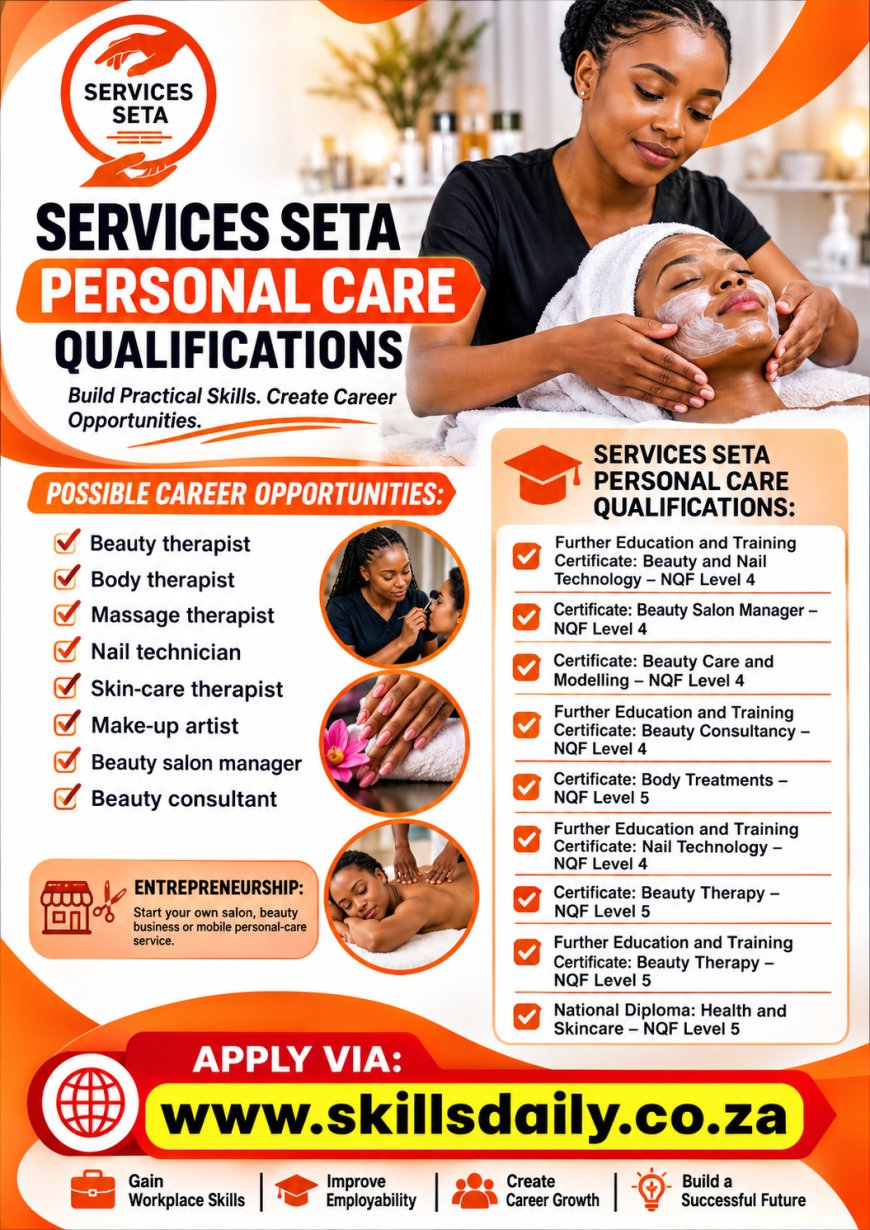
Services SETA lists qualifications including:
-
Further Education and Training Certificate: Beauty and Nail Technology – NQF Level 4
-
Certificate: Beauty Salon Manager – NQF Level 4
-
Certificate: Beauty Care and Modelling – NQF Level 4
-
Further Education and Training Certificate: Beauty Consultancy – NQF Level 4
-
Certificate: Body Treatments – NQF Level 5
-
Further Education and Training Certificate: Nail Technology – NQF Level 4
-
Certificate: Beauty Therapy – NQF Level 5
-
Further Education and Training Certificate: Beauty Therapy – NQF Level 5
-
National Diploma: Health and Skincare – NQF Level 5.
These qualifications can support careers in beauty salons, spas, skincare businesses and other personal-care environments.
Possible Career Opportunities
Graduates and appropriately trained practitioners may pursue opportunities such as:
-
Beauty therapist
-
Body therapist
-
Massage therapist
-
Nail technician
-
Skin-care therapist
-
Make-up artist
-
Beauty salon manager
-
Beauty consultant
The beauty sector can also provide opportunities for entrepreneurship, particularly for individuals who want to establish their own salon, beauty business or mobile personal-care service.
Hair Care and Hairdressing
Hair care is another important component of the Services SETA Personal Care sector. Hairdressing is recognised as a trade, meaning that training involves both theoretical and practical learning, followed by workplace experience and, where applicable, a trade-test pathway.
Services SETA lists the following hairdressing qualifications:
-
National Certificate: Hairdressing – NQF Level 2
-
National Certificate: Hairdressing – NQF Level 3
-
Further Education and Training Certificate: Hairdressing – NQF Level 4
-
Occupational Certificate: Hairdresser – NQF Level 4.
The occupational qualification for Hairdresser is also reflected in Services SETA's registered occupational qualifications, with Qualification ID 102497, at NQF Level 4 and a minimum of 540 credits.
Industry Applications
Hairdressing qualifications can be applied in:
-
Hair salons
-
Beauty salons
-
Spas and wellness businesses
-
Hair-care product businesses
-
Salon management
-
Mobile hairdressing services
-
Self-employed hairdressing businesses
Services SETA identifies occupations such as hairdresser, hair or beauty salon assistant and salon manager as employment opportunities within the hair-care subsector.
Funeral Services Qualifications
Personal Care also extends beyond beauty and hair care. Funeral services form another subsector, requiring specialised knowledge and practical skills to support families and funeral-service organisations.
Services SETA lists qualifications including:
-
National Certificate: Funeral Services Practice – NQF Level 3
-
National Certificate: Funeral Services Practice – NQF Level 4
-
National Diploma: Funeral Services Practice – NQF Level 5
-
Occupational Certificate: Mortician – NQF Level 3.
The newer occupational qualification framework also includes qualifications such as Occupational Certificate: Embalmer and Occupational Certificate: Embalmer's Assistant within the Personal Care subfield.
Career Opportunities
Training in funeral services can lead to opportunities including:
-
Funeral director
-
Mortician
-
Embalmer
-
Mortuary technician
-
Crematorium operator
-
Chapel or memorial attendant
-
Embalmer's assistant
The sector requires professionalism, sensitivity, attention to detail and the ability to work respectfully with bereaved families.
Fashion, Modelling and Image Consulting
The Personal Care chamber also includes fashion and modelling-related activities. Services SETA explains that modelling agencies may represent models, arrange portfolios and test shoots, coordinate bookings and work with designers, photographers and advertising agencies.
At present, Services SETA states that it has not yet developed qualifications specifically for modelling agencies and fashion design outside the clothing subsector. It also states that image consulting qualifications have not yet been developed by Services SETA, although work has been undertaken around registering the occupation and developing an occupational qualification.
This distinction is important for prospective learners: not every career associated with Personal Care necessarily has a Services SETA qualification attached to it.
Why Accreditation Matters
Learners should be careful when selecting a training provider. Services SETA advises learners and employers to use accredited Skills Development Providers (SDPs). Accreditation is intended to provide assurance that the provider has undergone an appropriate quality-assurance process and is authorised to offer relevant training.
Services SETA also provides a database through which learners can check whether a training provider is accredited to deliver its qualifications.
Choosing an accredited provider can therefore help learners avoid enrolling with providers that offer programmes without the appropriate recognition.
Personal Care Qualifications and Entrepreneurship
One of the strongest features of Personal Care training is its potential application to both employment and self-employment.
A qualified hairdresser, beauty therapist or nail technician may work for an established business while gaining experience and eventually establish an independent business. Possible business models include:
-
Beauty salons
-
Hair salons
-
Nail studios
-
Mobile beauty services
-
Mobile hairdressing
-
Skincare businesses
-
Massage and body-treatment services
-
Make-up services
-
Beauty product retail and distribution
This makes Personal Care skills particularly relevant to people interested in building a small business or developing an independent client base.
The Importance of Practical and Workplace Training
Modern occupational training increasingly emphasises the combination of knowledge, practical skills and workplace experience. Services SETA notes that occupational qualifications integrate these components to improve employability.
For Personal Care occupations, this practical component is particularly important because many professional activities require learners to demonstrate their skills in real or simulated workplace environments.
For example, a beauty learner may need to develop practical competence in treatments, while a hairdressing learner needs hands-on experience with clients, tools, products and salon procedures.
Recommended School Subjects
Services SETA identifies subjects such as English, Mathematics and Life Sciences as useful preparation for certain beauty-treatment pathways. Hairdressing and fashion-related pathways also recommend English and Mathematics.
Prospective learners should nevertheless check the specific admission requirements of the qualification and training provider before applying, because requirements can differ between programmes.
Who Can Benefit From These Qualifications?
Services SETA Personal Care qualifications may be suitable for:
-
School leavers looking for vocational career pathways
-
Unemployed young people seeking occupational skills
-
Existing salon employees wanting formal qualifications
-
People interested in starting beauty or hair-care businesses
-
Individuals looking to develop specialised personal-care skills
-
Workers seeking to progress into supervisory or management positions
-
People interested in funeral-service careers
Building a Career in the Personal Care Industry
The Personal Care sector provides multiple routes into the South African services economy. From hairdressing and beauty therapy to funeral services, the qualifications cover occupations that rely heavily on practical skills and customer service.
For learners, the key is to identify the occupation they want to pursue, determine which qualification is relevant, and then confirm that the training provider is properly accredited.
Services SETA's Personal Care information provides an overview of the recognised qualifications and career opportunities available within the sector.
Services SETA Personal Care qualifications can provide an important foundation for people seeking careers in beauty, hairdressing, skincare, nail technology and funeral services. Beyond traditional employment, these skills can also be used to establish small businesses and provide professional services directly to clients.
For anyone considering a Personal Care qualification, it is advisable to verify the qualification level, entry requirements, accreditation status of the training provider and workplace-training requirements before enrolling.
For the latest official information, learners can visit the Services SETA Personal Care page and use the Services SETA accredited-provider resources to verify training institutions.
What's Your Reaction?
 Like
0
 Dislike
0
 Love
1
 Funny
0
 Angry
0
 Sad
0
 Wow
0