




















CPUT Work Integrated Learning (WIL) Programme: Gain Practical Workplace Experience
CPUT Work Integrated Learning (WIL) Programme: Gain Practical Workplace Experience
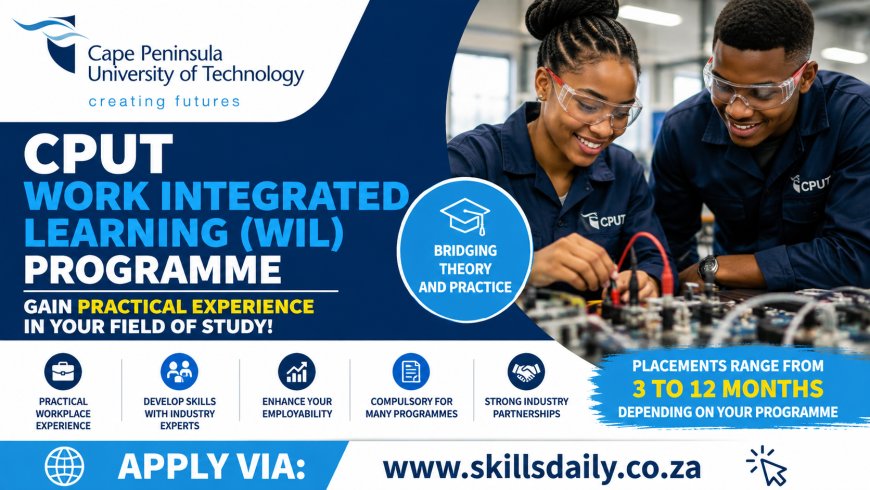
The Cape Peninsula University of Technology (CPUT) offers Work Integrated Learning (WIL) as an important part of many of its career-focused academic programmes. The initiative is designed to help students connect classroom theory with practical workplace experience and develop the skills needed to become work-ready graduates.
Through WIL, students can spend structured periods in industry, government departments or other organisations while they remain registered for their qualifications. CPUT says workplace placements can range from three to 12 months, depending on the requirements of the programme.
What Is Work Integrated Learning at CPUT?
Work Integrated Learning is a structured learning approach that allows students to apply the knowledge and skills gained during their studies to real workplace situations.
At CPUT, WIL is built around collaboration between students, the university and industry partners. Students receive guidance from workplace mentors as well as academic staff, helping them connect their academic studies with professional practice.
For many CPUT qualifications, WIL is a compulsory component. Placement requirements can differ according to the programme, the student's academic progress and the availability of organisations willing to host students.
How Long Does CPUT WIL Last?
The duration of a WIL placement depends on the student's discipline and qualification.
CPUT states that workplace-based learning placements can range from approximately three months to 12 months. Students should therefore consult their academic department to establish the exact WIL period applicable to their qualification.
Some programmes have specific structures. For example, CPUT's Department of Agriculture indicates that students complete two years of formal academic training before spending their third year gaining experiential learning in industry, such as on farms or within agricultural businesses.
Different WIL Opportunities at CPUT
CPUT uses several approaches to integrate workplace learning into its academic programmes.
1. Workplace-Based Learning
This is the primary WIL model and involves students being placed with an organisation to gain practical experience relevant to their qualification.
Students can work in industry or government organisations and gain exposure to actual workplace environments.
2. Project-Based Learning
Students may also work on real-world projects, either individually or in groups. These projects can involve organisations that provide actual workplace problems or cases for students to investigate and solve.
This model gives employers an opportunity to interact directly with students while contributing to their skills development.
3. Simulated Learning
Where direct workplace placements are limited, CPUT can use simulated environments, laboratories, case studies and campus-based projects to recreate workplace situations.
This allows students to practise applying their knowledge even when an external placement is not immediately available.
4. Work-Directed Theoretical Learning
Another approach is to connect classroom theory more closely with workplace practice through industry-related case studies, applied activities and problem-based tasks.
What Skills Can Students Gain?
One of the main purposes of WIL is to help students develop practical and professional competencies before completing their qualifications.
Students can gain experience in areas such as:
- Applying theoretical knowledge in practical situations.
- Workplace communication.
- Problem-solving.
- Teamwork.
- Professional conduct.
- Time management.
- Technical and occupational skills.
- Working with supervisors and colleagues.
- Understanding workplace procedures.
- Adapting to professional environments.
CPUT's Cooperative Education Unit describes WIL as an opportunity for students to demonstrate their abilities to potential employers and develop their potential through challenging workplace tasks.
Why WIL Is Important for CPUT Students
For students, one of the biggest advantages of WIL is the opportunity to gain pre-qualification workplace experience.
Graduates who have already spent time in a professional environment may have a better understanding of workplace expectations and can demonstrate practical experience when applying for jobs.
CPUT's Cooperative Education Unit highlights the importance of work experience in graduate employability and notes that WIL can provide students with workplace experience before they complete their academic studies.
CPUT has also emphasised WIL as a key part of its approach to producing work-ready graduates. In 2025, the university described WIL as a cornerstone of its educational approach and linked it to addressing the challenges of youth unemployment and skills development.
How CPUT Helps Students Find WIL Opportunities
Students who need WIL placements are encouraged to work closely with their academic departments.
CPUT's WIL guidance recommends that students:
- Prepare a professional CV.
- Prepare a cover letter.
- Engage with their academic department regarding placement support.
- Participate in career-readiness and employability workshops.
- Apply for suitable workplace opportunities.
The university's Cooperative Education Unit works with industry partners and departmental placement coordinators to facilitate workplace learning opportunities.
Students should not wait until the last minute to look for a placement. Because opportunities depend partly on the availability of industry partners, early preparation can be important.
WIL and Industry Partnerships
CPUT's WIL model relies heavily on partnerships with companies, government organisations and other external stakeholders.
The university's Centre for Community Engagement and Work Integrated Learning aims to strengthen partnerships with industry, private organisations and communities so that students can apply their knowledge in real-life situations.
In 2024, CPUT held a WIL industry engagement event involving organisations that host students across its faculties. The university highlighted the importance of maintaining strong partnerships between employers and the institution to improve students' WIL experiences.
Benefits for Employers
WIL is not only beneficial to students. Employers that host CPUT students can gain access to emerging talent while contributing to South Africa's skills development.
According to CPUT, industry partners can also participate in advisory structures that help communicate industry needs to the university and influence the training students receive.
For an employer, hosting a WIL student can therefore be an opportunity to:
- Develop young talent.
- Contribute to skills development.
- Introduce students to the organisation.
- Identify potential future employees.
- Bring fresh ideas into the workplace.
- Strengthen relationships with higher education.
Is WIL Compulsory at CPUT?
WIL is compulsory for many CPUT qualifications, but the exact requirements depend on the programme.
Students should not assume that every qualification has the same WIL structure. The required duration, timing, assessment methods and workplace requirements can vary between programmes and faculties.
CPUT's current learning, teaching and assessment policy states that WIL can be delivered through different modalities, including workplace learning, problem-based learning, project-based learning, work-directed theoretical learning and simulations. It also provides for WIL to be credit-bearing and subject to assessment.
WIL Assessment and Logbooks
WIL is not simply about attending a workplace. Students are expected to demonstrate what they have learned.
CPUT's WIL information indicates that students may be required to keep logbooks, have their progress monitored by workplace supervisors or mentors and complete assignments or projects linked to their workplace experience.
The university's current policy also provides for formative assessment and feedback during WIL, with possible assessment activities including workplace-oriented reports, simulations, reflective journals, role-plays and other appropriate tasks.
CPUT WIL Opportunities Across Different Fields
WIL is used across a wide range of disciplines at CPUT. The university's WIL model covers different faculties and occupational fields, with workplace experiences tailored to the requirements of individual programmes.
Examples include opportunities connected to areas such as:
- Engineering and technology.
- Agriculture.
- Business and commerce.
- Information technology.
- Hospitality and tourism.
- Marketing.
- Accounting.
- Internal auditing.
- Other career-focused disciplines.
CPUT has previously highlighted WIL partnerships involving students in IT, Accounting, Internal Auditing and Marketing, while its Agriculture Department provides structured experiential learning through placements in agricultural businesses and farms.
How to Prepare for CPUT WIL
Students preparing for their WIL placement should start early.
Prepare a Professional CV
Your CV should clearly state:
- Your qualification.
- Current year of study.
- Relevant subjects.
- Technical skills.
- Computer skills.
- Previous experience.
- Contact details.
- Availability for WIL.
Prepare for the Workplace
Students should also develop professional skills before starting their placement. This includes communication, teamwork, punctuality, workplace etiquette and problem-solving.
CPUT's Cooperative Education Unit provides career-readiness and employability support to help students prepare for entering the workplace.
Speak to Your Academic Department
Your department should be one of your first points of contact because WIL requirements vary between qualifications. Students should establish when they need to complete WIL, how long the placement must be and what documentation or assessments are required.
CPUT Work Integrated Learning at a Glance
| Feature | Details |
|---|---|
| Institution | Cape Peninsula University of Technology (CPUT) |
| Programme | Work Integrated Learning (WIL) |
| Purpose | Connect academic learning with workplace experience |
| Duration | Approximately 3–12 months, depending on programme |
| Placement Areas | Industry, government and other approved organisations |
| Eligibility | Depends on the student's qualification |
| Assessment | Programme-specific and credit-bearing where applicable |
| Support | Academic departments and Cooperative Education Unit |
| Workplace Mentor | Yes, depending on placement |
| CV Required | Students are encouraged to prepare a professional CV |
| Main Benefit | Practical experience and improved workplace readiness |
Final Thoughts
The Cape Peninsula University of Technology Work Integrated Learning programme gives students an important opportunity to move beyond classroom theory and experience the realities of the workplace.
With workplace placements, project-based learning, simulations and work-directed theoretical learning forming part of CPUT's WIL approach, students can develop practical competencies while completing the requirements of their qualifications.
For CPUT students who need WIL, the best starting point is to contact their academic department and the Cooperative Education Unit, prepare a strong CV and begin searching for suitable placement opportunities early.
Official CPUT WIL information: CPUT Work Integrated Learning
What's Your Reaction?
 Like
0
 Dislike
0
 Love
1
 Funny
0
 Angry
0
 Sad
0
 Wow
0