





















K53 Learner’s Licence Free Self-Grading Quiz: Practise Road Signs, Rules of the Road and Vehicle Controls
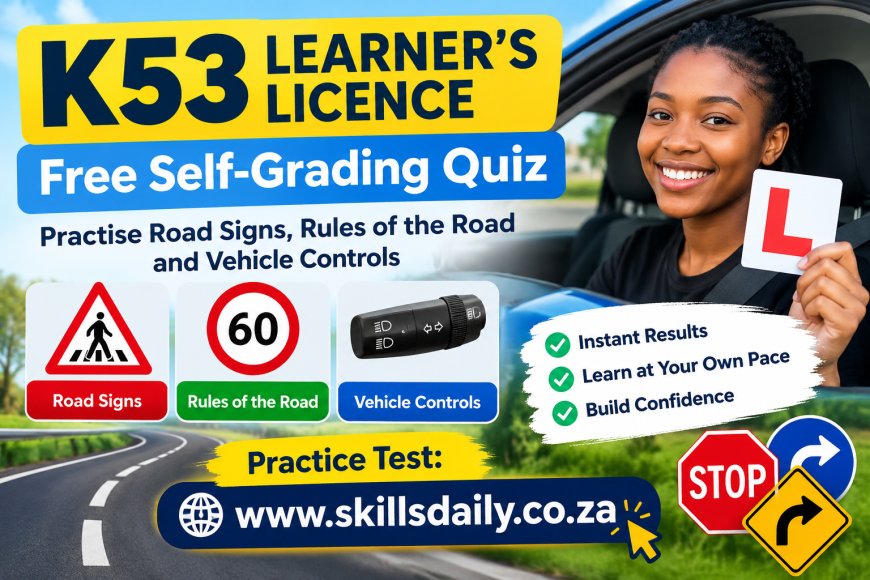
K53 Learner’s Licence Free Self-Grading Quiz: Practise Road Signs, Rules of the Road and Vehicle Controls
Are you preparing for your K53 learner’s licence test in South Africa? A free self-grading quiz is a useful way to test your knowledge, identify areas that need improvement and prepare for the official learner’s licence examination.
The K53 learner’s licence test assesses your understanding of road signs, rules of the road and motor vehicle controls. Practising questions before your test can help you become more familiar with traffic regulations and improve your confidence.
Whether you are applying for a Code 1 motorcycle learner’s licence or a Code 2 or Code 3 motor vehicle learner’s licence, it is important to study the rules that apply to your intended vehicle category.
What Is a K53 Learner’s Licence Self-Grading Quiz?
A K53 self-grading quiz is a practice assessment that checks your answers and calculates your score automatically. Instead of marking every answer manually, you receive feedback on your performance after completing the questions.
A self-grading quiz can help you:
-
Test your knowledge of South African road signs.
-
Understand important road rules and traffic regulations.
-
Learn about vehicle controls and their functions.
-
Identify topics that require more revision.
-
Practise answering multiple-choice questions.
-
Build confidence before taking the official test.
Important: A practice quiz is a study tool, not an official learner’s licence examination. Passing a practice quiz does not guarantee that you will pass the test at a driving licence testing centre.
Topics Covered in the K53 Learner’s Licence Quiz
1. Road traffic signs
Road signs communicate instructions, warnings and information to drivers. You should learn to recognise regulatory signs, warning signs, direction signs, information signs and temporary roadwork signs.
2. Rules of the road
This section covers speed limits, right of way, overtaking, following distances, intersections, parking, stopping and the responsibilities of road users.
3. Motor vehicle controls
You should understand the functions of indicators, headlights, brake lights, windscreen wipers, the accelerator, brakes, clutch and other relevant vehicle controls.
4. Road safety
Road safety questions help you understand how to respond to hazards, protect pedestrians, maintain a safe distance from other vehicles and drive responsibly in different conditions.
How to Use a Free Self-Grading Quiz
Follow these steps to get the most out of your practice session:
-
Read each question carefully.
-
Select the answer you believe is correct.
-
Complete the quiz before checking your study notes.
-
Submit your answers to receive your score and feedback.
-
Review the questions you answered incorrectly.
-
Study the relevant topic and attempt another practice quiz.
For the best results, practise regularly rather than relying on a single attempt.
Where to Find K53 Learner’s Licence Study Resources
You can prepare using a reliable K53 study manual, road-sign guides and online practice tests that focus on South African traffic rules.
For official information about applying for a learner’s licence, visit the South African Government website:
You can also check booking procedures through the official eNaTIS website:
Always confirm application requirements, fees and booking arrangements with the relevant licensing authority.
K53 Learner’s Licence in South Africa: Requirements, Application Process, Test Questions and Study Tips
Are you planning to obtain your learner’s licence in South Africa? The K53 learner’s licence is the first important step towards becoming a licensed driver. It helps you understand South African road rules, traffic signs, road markings and vehicle controls before you begin driving under the required supervision.
Whether you are a school leaver, a student, a job seeker or an adult who wants to become a driver, obtaining a learner’s licence can open up opportunities for personal independence and future employment that requires driving skills.
This article explains the K53 learner’s licence, the different licence codes, minimum age requirements, application process, test preparation resources and tips to help you pass the examination.
What Is a K53 Learner’s Licence?
A K53 learner’s licence is an official document issued to a person who has passed the learner’s licence examination. It permits the holder to learn to drive a motor vehicle on public roads, subject to the applicable supervision and legal requirements.
The K53 system focuses on safe driving practices, knowledge of traffic regulations and responsible behaviour on the road.
Before applying for a full driving licence, you must obtain the appropriate learner’s licence and practise driving in accordance with the law.
A learner’s licence does not allow you to drive independently. You must comply with the supervision conditions applicable to your vehicle category.
Types of Learner’s Licences in South Africa
South Africa has different learner’s licence categories depending on the type of vehicle you intend to drive.
Code 1: Motorcycles
Code 1 applies to motorcycles. The minimum age is generally:
-
16 years for a motorcycle with an engine capacity not exceeding 125 cc.
-
18 years for other motorcycles.
Code 2: Light Motor Vehicles
Code 2 covers motor vehicles within the applicable vehicle mass limits, including ordinary passenger cars.
The minimum age to apply for a Code 2 learner’s licence is generally 17 years.
Code 3: Heavy Motor Vehicles
Code 3 applies to heavy motor vehicles within the relevant category.
The minimum age to apply for a Code 3 learner’s licence is generally 18 years.
Applicants should confirm the exact vehicle classification and current requirements with their nearest driving licence testing centre.
Requirements for a K53 Learner’s Licence
Before applying, make sure you meet the minimum age requirement for your selected category.
Applicants generally need the following:
-
A valid South African identity document or another accepted identification document.
-
A completed learner’s licence application form, usually form LL1.
-
Two identical photographs if required by the relevant testing centre.
-
Proof of residential address where required.
-
Payment of the prescribed application and testing fees.
-
Completion of an eye test or submission of an acceptable eye examination certificate, according to the applicable requirements.
It is advisable to contact your local driving licence testing centre before visiting to confirm the documents, photographs, fees and booking arrangements required.
How to Apply for a K53 Learner’s Licence
Follow these steps to apply for your learner’s licence in South Africa.
Step 1: Choose your learner’s licence code
Decide which category you need based on the type of vehicle you want to learn to drive.
Step 2: Book your learner’s licence test
Contact your nearest driving licence testing centre to establish the booking process and available dates.
In Gauteng, applicants can also check the relevant online booking arrangements through the official eNaTIS system.
Step 3: Complete the application form
Complete the required application form and prepare your supporting documents.
Step 4: Complete the eye test
You will generally need to undergo an eye test to establish whether you meet the applicable vision requirements for driving.
Step 5: Pay the required fees
Pay the prescribed application and testing fees as instructed by the licensing authority.
Step 6: Study for the K53 examination
Prepare for the examination by studying the rules of the road, road signs, road markings and motor vehicle controls.
Step 7: Write the examination
Arrive at the testing centre on your scheduled date with the required documents. Follow the examiner’s instructions and complete the examination.
If you pass, follow the testing centre’s instructions for the issuing of your learner’s licence.
What Does the K53 Learner’s Licence Test Cover?
The examination tests your knowledge of three main areas.
1. Rules of the Road
You should understand the rules governing intersections, speed limits, overtaking, following distances, stopping, parking and the responsibilities of drivers towards other road users.
2. Road Traffic Signs
Learn to recognise and understand regulatory signs, warning signs, information signs, direction signs and temporary roadwork signs.
You should also understand road markings and how they influence the movement of traffic.
3. Motor Vehicle Controls
You need to know the functions of vehicle controls such as indicators, headlights, brake lights, windscreen wipers, the accelerator, clutch and brakes.
Understanding these topics will help you prepare for the learner’s licence examination and develop a foundation for safe driving.
K53 Learner’s Licence Free Practice Tests
Free practice tests can help you prepare for the official examination. They allow you to answer questions, assess your knowledge and identify topics that require further revision.
A useful practice test should cover:
-
Road signs and their meanings.
-
Rules of the road.
-
Vehicle controls.
-
Traffic lights and intersections.
-
Safe following distances.
-
Overtaking and right-of-way rules.
-
General road safety.
Some online quizzes offer automatic marking or self-grading, allowing you to review your score after completing the questions.
Remember that online practice questions are study resources and do not replace the official learner’s licence examination.
How to Prepare for the K53 Test
Passing the learner’s licence test requires preparation and a good understanding of South African road rules.
Use these study tips to improve your readiness.
Study the K53 manual: Use a reliable South African learner’s licence study guide to learn the applicable traffic rules.
Practise road signs: Spend time learning the meaning of different signs, including their shapes, colours and symbols.
Take self-grading quizzes: Complete practice questions and review the explanations for incorrect answers.
Understand the rules: Do not rely only on memorising answers. Understanding why a road rule applies will help you answer unfamiliar questions.
Revise regularly: Study a little each day instead of attempting to learn everything immediately before the examination.
Read questions carefully: Pay attention to the wording of each question and consider all the available answers before selecting one.
How Long Is a Learner’s Licence Valid?
A learner’s licence in South Africa is valid for 24 months and cannot be extended.
During this period, you should practise driving under the required supervision and prepare for your practical driving test.
The learner’s licence must be appropriate for the vehicle you are learning to drive. You must also comply with the legal conditions applicable to your category.
How Much Does a K53 Learner’s Licence Cost?
The cost depends on the applicable fees charged by the relevant licensing authority.
Applicants should budget for the booking, testing and issuing fees, as applicable. Additional costs may arise if you use a driving school or purchase study materials.
Since fees can change, contact your local driving licence testing centre for the latest amounts before applying.
What Happens If You Fail the Learner’s Licence Test?
If you do not pass, you will generally need to arrange another test date and pay the applicable fees.
Use your first attempt as an opportunity to identify areas that need improvement. Revise road signs, vehicle controls and the rules of the road before taking the examination again.
Make sure you understand the mistakes you made rather than simply memorising the answers.
Official K53 Learner’s Licence Resources
For reliable information about learner’s licence requirements and the application process, consult official South African resources.
These resources can help you check application requirements and relevant booking information.
Frequently Asked Questions
1. At what age can I apply for a learner’s licence?
The minimum age depends on the category. It is generally 16 for motorcycles up to 125 cc, 17 for Code 2 and 18 for Code 3 and other motorcycles.
2. Can I drive alone with a learner’s licence?
No. You must drive under the supervision required by law for your learner’s licence category.
3. How long does a learner’s licence remain valid?
It is valid for 24 months and cannot be extended.
4. Can I use free online quizzes to prepare?
Yes. Practice quizzes can help you test your knowledge of road signs, road rules and vehicle controls. However, they do not guarantee that you will pass the official examination.
5. Can I apply for a learner’s licence online?
Online booking options are available through eNaTIS, subject to the applicable procedures and availability. Check the official system and your local testing centre for current instructions.
Conclusion
Obtaining a K53 learner’s licence is an important step towards becoming a responsible and qualified driver in South Africa. By meeting the requirements, completing the application process and preparing thoroughly for the examination, you can improve your chances of passing.
Start by selecting the correct licence category, checking the required documents and booking your test. Use reliable study guides and free self-grading quizzes to strengthen your understanding of road signs, traffic rules and vehicle controls.
With consistent preparation and a commitment to road safety, you can take the first step towards obtaining your full driving licence.
What's Your Reaction?
 Like
0
 Dislike
0
 Love
1
 Funny
0
 Angry
0
 Sad
0
 Wow
0