






















X12 SETA-Accredited Learnerships and X4 Skills Development Programmes at Progression
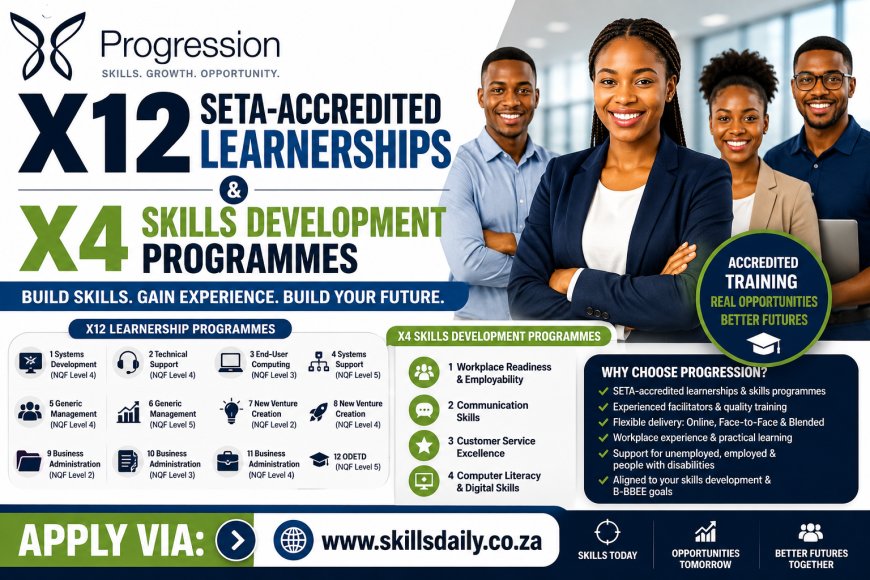
SETA-Accredited Learnerships and Skills Development Programmes at Progression
Skills development remains a critical part of South Africa’s efforts to address unemployment, close workplace skills gaps and create pathways into sustainable employment. For employers, structured training can also support transformation and B-BBEE objectives, while for learners, accredited programmes can provide valuable knowledge, recognised qualifications and workplace experience.
Progression is an accredited training and skills development provider offering a range of SETA-accredited learnerships and skills development programmes, together with face-to-face, online and blended training solutions. The organisation works with businesses to develop skills interventions aligned with strategic objectives and transformation requirements.
What Does Progression Offer?
Progression's Skills Development offering includes:
- SETA-accredited learnerships
- SETA-accredited skills programmes
- Skills development strategies
- Bursaries
- Internships
- Apprenticeships
- Hosted learnerships
- Work-readiness programmes
- Recruitment and support of learners
- Self-leadership and coaching programmes
The provider offers programmes through different delivery models, including face-to-face, online and blended learning, allowing organisations to select an approach that suits their workforce and training requirements.
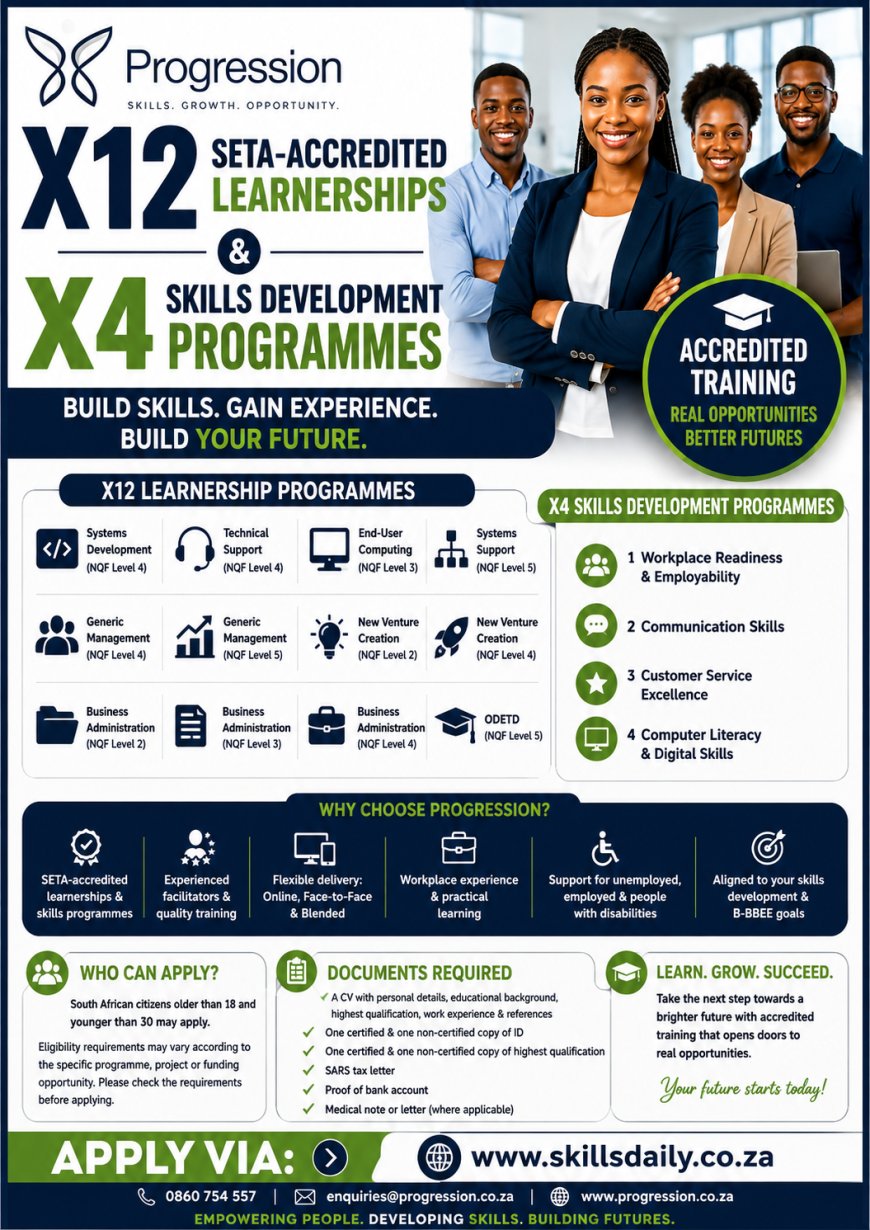
SETA-Accredited Learnership Programmes
Progression's learnership portfolio covers several occupational and business areas. Its website currently lists programmes in fields including Information Technology, management, business administration, entrepreneurship and education, training and development.
Systems Development – NQF Level 4
The Systems Development qualification provides learners with an entry point into the Information Technology sector, particularly systems development and computer sciences. It is intended to help learners build foundational knowledge and skills that can be applied within the IT industry.
Technical Support – NQF Level 4
The Technical Support programme provides a foundation for individuals interested in computer sciences and information technology, specifically systems support. It can help learners develop competencies relevant to technical support environments.
Progression currently highlights Technical Support NQF 4 as one of its featured programmes and states that entry requirements include communication, mathematical literacy and computer literacy at NQF Level 3 and/or a Grade 11 pass.
End-User Computing – NQF Level 3
The End-User Computing programme is designed to develop the knowledge, skills, attitudes and values required to operate confidently in an end-user computing environment.
This type of programme can be particularly useful for learners who want to strengthen their computer skills for administration, business and other technology-enabled workplaces.
Systems Support – NQF Level 5
The Systems Support qualification provides an undergraduate-level entry into networking and systems support. Progression states that the qualification can also provide credits towards further tertiary studies in Computer Studies or Computer Science.
Generic Management – NQF Levels 4 and 5
Progression offers Generic Management programmes at NQF Levels 4 and 5.
The NQF Level 4 programme provides a foundation for developing management qualifications across different sectors and industries. The NQF Level 5 programme covers areas including leadership, managing the business environment, relationships and knowledge.
These programmes may be suitable for employees who are already working in supervisory or management environments, as well as individuals seeking to develop their management capabilities.
New Venture Creation – NQF Levels 2 and 4
Progression also lists New Venture Creation programmes at NQF Levels 2 and 4.
The programmes are designed to develop knowledge and skills associated with establishing and developing small businesses. This makes them relevant to aspiring entrepreneurs and individuals interested in enterprise development.
Business Administration – NQF Levels 2, 3 and 4
Business Administration is another significant area within Progression's learnership portfolio.
The programmes cover competencies relevant to administration functions within organisations and businesses. The higher-level programme includes areas such as records management and comprehension of written and verbal information, while the NQF Level 3 programme includes information handling, communication, customer service, technology and organisational skills.
ODETD – NQF Level 5
The Occupationally Directed Education, Training and Development Practices (ODETDP) qualification is aimed at individuals seeking to enter the education, training and development field.
Progression states that the qualification is useful for people such as learning facilitators, Skills Development Facilitators and assessors. It is intended for individuals who have a FETC or equivalent and expertise in the subject or occupational field in which they intend to provide education, training and development.
SETA-Accredited Skills Development Programmes
Learnerships are not the only training solution available through Progression. The organisation also provides SETA-accredited skills programmes designed to address specific workplace and skills development requirements.
Skills programmes can be particularly useful when an organisation needs targeted training rather than a full qualification. They can be incorporated into broader employee development strategies and tailored to specific organisational needs.
Progression describes its programmes as being aligned with client strategic objectives and designed to support meaningful transformation rather than simply meeting compliance requirements.
Supporting Employers With Skills Development
For employers, implementing a learnership or skills development programme can involve much more than selecting a qualification. Organisations need to consider learner recruitment, registration, training, workplace exposure, monitoring, reporting and supporting learners throughout the intervention.
Progression offers end-to-end learnership implementation, including registration, onboarding, training, monitoring and reporting. Its newer Skills Development offering also highlights options for both employed and unemployed learners, as well as programmes focused on people with disabilities.
This integrated approach can help businesses manage their skills development initiatives while focusing on their core operations.
Learnerships for Unemployed and Employed Learners
Progression's skills development solutions are designed to accommodate different learner categories. Its current offering includes options for both employed and unemployed learners.
For unemployed individuals, learnerships can provide a route to structured training and workplace exposure. For employers, learnerships can support the development of new talent while contributing to broader transformation and skills development objectives.
Progression has previously emphasised the importance of ensuring that learnerships deliver genuine skills transfer and help learners become more employable rather than treating learnerships simply as a compliance exercise.
Opportunities for People With Disabilities
An important part of Progression's skills development approach is its focus on disability inclusion.
The organisation has extensive experience in disability management and provides programmes designed to help integrate people with disabilities into the workplace. Its current Skills Development offering includes disability-focused learnerships and workplace-readiness programmes.
Progression also states that its QCTO programmes can be delivered alongside structured workplace experience through QCTO-approved Employment Hubs, including opportunities in areas such as Payroll Management, Advertising, Computer Technology, Cloud Administration, Sewing Machine Operation, Project Management and Office Administration.
Face-to-Face, Online and Blended Learning
Modern workplaces require flexible approaches to training. Progression offers face-to-face, online and blended training solutions, allowing organisations to choose delivery methods based on their operational requirements.
Online and blended learning can be particularly useful for organisations with employees or learners located in different areas, while classroom-based learning can provide greater direct interaction between facilitators and participants.
Skills Development and B-BBEE
Skills development can form an important component of an organisation's transformation strategy.
Progression states that its programmes are designed to maximise B-BBEE value while aligning training interventions with the client's strategic objectives and broader transformation goals.
Its current Skills Development service also highlights support for B-BBEE scorecard objectives, SETA funding opportunities, tax-related benefits and Workplace Skills Plan and Annual Training Report support. Businesses should, however, obtain professional advice and confirm the current applicable B-BBEE and tax requirements for their specific circumstances.
The Move From SETA Legacy Qualifications to QCTO Programmes
South Africa's skills development landscape is undergoing a significant transition from historical SETA-registered qualifications towards QCTO occupational qualifications.
Progression's latest information explains that the transition affects how employers plan learnerships, access funding, approve workplaces, conduct assessments and structure skills development strategies.
As a result, employers and prospective learners should check the current accreditation, registration status, intake dates and eligibility requirements of a specific programme before enrolling. Progression's website now features both SETA-related offerings and QCTO-aligned occupational programmes.
This is particularly important because the availability and registration status of individual legacy qualifications can change during the transition.
Why Consider Progression?
Progression offers a broad skills development portfolio that can benefit both organisations and learners.
Key features include:
- Accredited training: Programmes include SETA-accredited learnerships and skills programmes, alongside QCTO-aligned offerings.
- Multiple learning formats: Face-to-face, online and blended learning options are available.
- Wide programme selection: Training covers business administration, management, IT, entrepreneurship and other areas.
- Learner support: Progression provides recruitment and support services for learners participating in learning interventions.
- Workplace exposure: Its programmes can incorporate practical workplace experience and employment-hub solutions.
- Disability inclusion: Dedicated disability management and inclusion solutions are available.
- Corporate skills development: Training solutions can be aligned with organisational transformation and workforce objectives.
A Partner for Skills Development and Transformation
Progression has positioned itself as a skills development partner for organisations looking to build capable workforces while advancing transformation objectives. Its portfolio ranges from learnerships and skills programmes to internships, apprenticeships, bursaries, work-readiness initiatives and hosted learnership solutions.
For learners, the available programmes provide opportunities to develop skills in areas such as business administration, management, IT, entrepreneurship and education and training.
For employers, Progression provides a more comprehensive approach that can include learner recruitment, programme implementation, monitoring, reporting and workplace support.
SETA-accredited learnerships and skills development programmes at Progression provide organisations and learners with a range of options for structured training and workforce development. From Business Administration and Generic Management to IT, New Venture Creation and ODETD, the programmes cover several career and business-focused fields.
With South Africa's transition towards the QCTO system continuing, prospective learners and employers should always verify the latest programme availability, accreditation, registration status and entry requirements directly with Progression before making an application or implementing a programme.
Find out more:
Progression Learnership Programmes
What's Your Reaction?
 Like
5
 Dislike
0
 Love
2
 Funny
0
 Angry
0
 Sad
1
 Wow
1