






















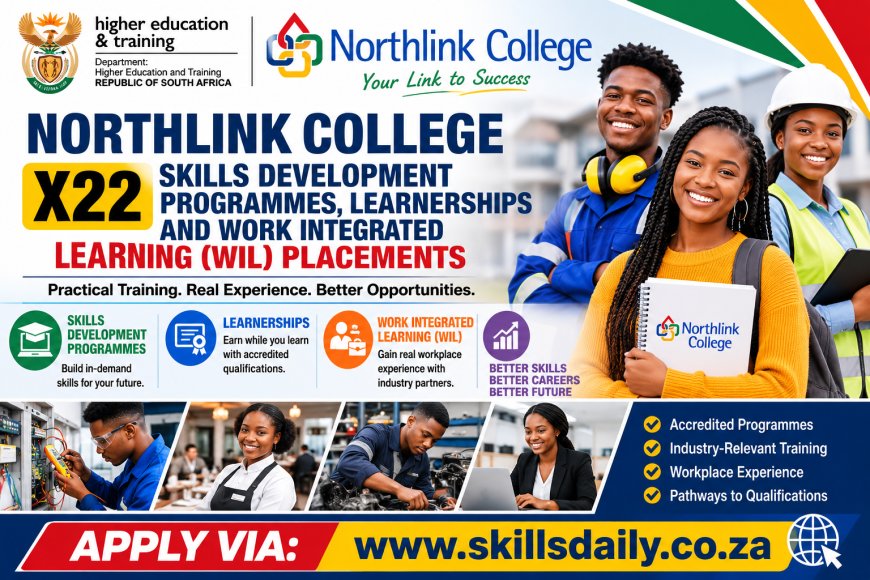
X22 Northlink College Skills Development Programmes, Learnerships and Work Integrated Learning Placements

Northlink College Skills Development Programmes, Learnerships and Work Integrated Learning Placements
Northlink TVET College is a nationally registered public Technical and Vocational Education and Training (TVET) college in the Western Cape, focused on providing accessible, accredited education and practical training that helps bridge the gap between education and the world of work. The college offers a variety of programmes, including occupational training, learnerships, skills programmes and Work Integrated Learning (WIL) opportunities.
For learners looking to gain practical skills, obtain recognised qualifications or gain workplace experience, Northlink's combination of classroom-based education and workplace exposure provides several pathways towards career development.
Skills Development at Northlink College
Northlink College offers skills programmes as part of its occupational training portfolio. Skills programmes are designed around specific occupational skills and can provide credits towards a qualification on the National Qualifications Framework (NQF). Northlink explains that skills programmes can consist of individual unit standards or clusters of unit standards that develop specific employable skills.
This approach allows learners to focus on particular skills without necessarily having to complete an entire qualification immediately.
Skills programmes can therefore be useful for:
-
Employees who want to upgrade specific workplace skills
-
Unemployed people looking to improve their employability
-
Employers developing their workforce
-
Learners who need particular occupational competencies
-
People who want to build credits towards a larger qualification
Northlink's broader occupational-training offering includes learnerships, short skills programmes, trade tests, Competency-Based Modular Training (CBMT) and Centres of Specialisation.
Northlink College Learnerships
Learnerships are an important part of Northlink's occupational training offering. According to Northlink, a learnership combines structured learning with practical workplace experience and leads to a qualification registered on the NQF.
The college explains that a typical learnership consists of approximately 30% institutional training and 70% workplace-based practical experience, although the exact structure can vary according to the programme. This model enables learners to take knowledge gained in the classroom and apply it in an actual working environment.
Northlink's current learnership qualification listings include programmes in technical, engineering and occupational fields.
Examples include:
-
Beauty Therapist
-
Autotronics
-
Engineering Fabrication
-
Welding Application and Practice
-
Mechanical Engineering
-
Pipe-Fitting
-
Automotive Repair and Maintenance
-
Automotive Spray Painting
The college lists qualifications at different NQF levels, including programmes from NQF Level 2 through NQF Level 4 and beyond, depending on the specific qualification.
Practical Learning Through Learnerships
A major advantage of a learnership is that learners do not only study theory. They also have the opportunity to apply their knowledge in a workplace.
Northlink describes learnerships as involving cooperation between the college, learner and workplace. A learnership involves formal agreements between the relevant parties, with the workplace providing the environment where practical skills can be developed.
This workplace component can help learners develop:
-
Technical competence
-
Communication skills
-
Professional workplace behaviour
-
Problem-solving abilities
-
Teamwork
-
Occupational confidence
-
Experience using workplace equipment and processes
For young people entering the labour market, this practical exposure can be particularly valuable because it allows them to gain experience while completing their training.
Work Integrated Learning at Northlink
Work Integrated Learning (WIL) is another important component of Northlink's approach to preparing students for employment.
Northlink defines WIL as an educational approach that intentionally combines theoretical knowledge with authentic or practical work. The objective is to connect academic learning with workplace practices in a way that benefits the student.
The purpose of WIL placements is to give students relevant work experience in a suitable workplace related to their course of study. Northlink notes that these placements can help confirm students' competencies while strengthening their employability skills.
Types of WIL Placements
Northlink provides several forms of workplace exposure, depending on the student's programme and training requirements.
Job Shadowing
Job shadowing provides students with short-term exposure to the workplace. Northlink states that some students may require only a few days of workplace exposure, such as a five-day placement, to gain an understanding of the real working environment.
Job shadowing can help learners understand:
-
Workplace routines
-
Professional conduct
-
Occupational roles
-
Communication
-
Customer interaction
-
Organisational structures
Internships
Internships provide a substantially longer period of workplace experience. Northlink describes internships as potentially lasting 18 months to two years, particularly for students who have completed institutional programmes such as N6.
This extended workplace exposure allows students to develop occupational competence through repeated application of their knowledge. On completion of the required period, eligible students may apply for a National Diploma through the DHET process.
Apprenticeships
Apprenticeships combine employment and workplace training over a defined period. Learners work under the guidance of experienced personnel while developing practical occupational skills.
Northlink explains that apprentices gain workplace experience that can prepare them to apply for a trade test.
This route is particularly relevant to technical and engineering careers where practical competence is essential.
Learnerships
Learnerships are another form of work-integrated training. They combine structured institutional learning with on-the-job training and are designed to lead to qualifications on the NQF.
This makes learnerships different from conventional classroom-only education because workplace experience forms an integral part of the learning process.
Connecting Students With Employers
WIL depends heavily on partnerships between educational institutions and employers.
Northlink invites organisations to host students and participate in workplace partnerships. The college highlights several potential benefits for host employers, including access to students with new ideas and energy, opportunities to influence education and occupational delivery, partnerships with TVET institutions, and support for addressing scarce and critical skills.
Northlink also identifies potential B-BBEE and tax-related benefits for qualifying employers, subject to applicable rules and the employer's circumstances. Businesses should confirm their eligibility and requirements with the relevant authorities or professional advisers.
Simulation Centres and Practical Training
Where appropriate, Northlink also uses simulation centres to give students practical exposure. The college identifies simulation facilities in areas including:
-
Wholesale and Retail
-
Safety in Society
-
Educare
-
Haircare
-
Cosmetology
-
Restaurant and Conference Services
These facilities can complement workplace placements by allowing students to practise occupational tasks in structured environments.
Examples of Skills Training
Northlink's skills-development portfolio extends across technical and occupational areas. Its published material includes engineering-related skills programmes, while its annual reporting also demonstrates delivery of skills programmes in areas such as Assistant Chef, Fire Marshal, First Aid, electrical installation testing and renewable-energy-related training.
The college's 2023 annual report, for example, recorded National Skills Fund-supported training involving apprenticeships, learnerships and skills programmes. The reported learnerships included IT Technical Support and Early Childhood Development, while skills-programme beneficiaries included areas such as Assistant Chef and safety-related training.
Programme availability can change according to funding, projects, employer partnerships and enrolment cycles, so prospective learners should check the latest Northlink listings before applying.
Why Work Experience Matters
One of the biggest challenges facing people entering the labour market is the gap between theoretical education and practical workplace experience.
WIL helps address this gap by allowing students to practise their skills in real or simulated work environments. Rather than simply learning about an occupation, learners can experience workplace expectations, processes, equipment, communication and professional standards.
Northlink has previously partnered with employers to create workplace opportunities. For example, the college reported a long-standing WIL relationship with ABSA Bank, which provided job-shadowing opportunities for NCV Level 4 students and longer placements for N6 students.
Such partnerships demonstrate how collaboration between TVET colleges and employers can help students become more work-ready.
Benefits for Learners
Northlink's combination of skills programmes, learnerships and WIL placements can provide several advantages for learners:
Practical experience: Learners can apply classroom knowledge in workplace environments.
Employability skills: Workplace exposure can help develop communication, teamwork, problem-solving and professional behaviour.
Occupational competence: Technical and occupational programmes provide opportunities to develop practical capabilities relevant to specific careers.
Recognised learning: Learnerships and skills programmes can contribute towards recognised qualifications and NQF credits, depending on the programme.
Career exposure: Job shadowing, internships and workplace placements can help students understand what working in a particular occupation is actually like.
Industry connections: Workplace placements can introduce learners to employers and industry professionals.
Benefits for Employers
Employers can also benefit from participating in Northlink's workplace-placement programmes.
By hosting students, organisations can contribute to skills development while gaining access to potential future employees. Employers can also help influence the development of students by providing practical exposure to current industry practices.
Northlink identifies benefits such as access to students, partnerships with TVET colleges, addressing scarce and critical skills, and contributing to reducing unemployment.
Who Can Consider Northlink's Programmes?
Northlink's skills development, learnership and workplace-training opportunities can be relevant to:
-
School leavers
-
Unemployed youth
-
Existing employees
-
N6 students requiring workplace experience
-
Students completing occupational programmes
-
People seeking technical and trade-related careers
-
Employers looking to host students
-
Organisations seeking workforce development partnerships
Requirements differ between programmes. Learners should therefore check the specific qualification, entry requirements, funding arrangements and application dates before applying.
Final Thoughts
Northlink College's Skills Development programmes, Learnerships and Work Integrated Learning placements provide different pathways for people who want to develop practical skills and improve their connection to the workplace.
Its learnership model combines structured learning with practical experience, while skills programmes allow learners to focus on specific occupational competencies. WIL placements add another important dimension by connecting students directly with employers through job shadowing, internships, apprenticeships and other forms of workplace exposure.
For employers, partnering with Northlink can provide an opportunity to contribute to skills development, help address industry skills shortages and build relationships with future talent.
Northlink's official website currently describes the college as offering 70+ courses, seven campuses and more than 20,000 students annually, alongside occupational training, learnerships and short skills programmes.
Find Out More
Prospective learners can explore Northlink's official pages for the latest information on:
X21 Edge Training Accredited SETA Skills Development Learnership Programmes and X19 Short Courses
Important: Learnerships, skills programmes and WIL opportunities may have specific entry requirements, funding arrangements, workplace-placement requirements and closing dates. Applicants should verify the latest details directly with Northlink College before applying.
What's Your Reaction?
 Like
1
Like
1
 Dislike
0
Dislike
0
 Love
0
Love
0
 Funny
0
Funny
0
 Angry
0
Angry
0
 Sad
0
Sad
0
 Wow
0
Wow
0