




















X46 SA Business School Accredited Programmes: Learnerships, QCTO Programmes and Skills Programmes
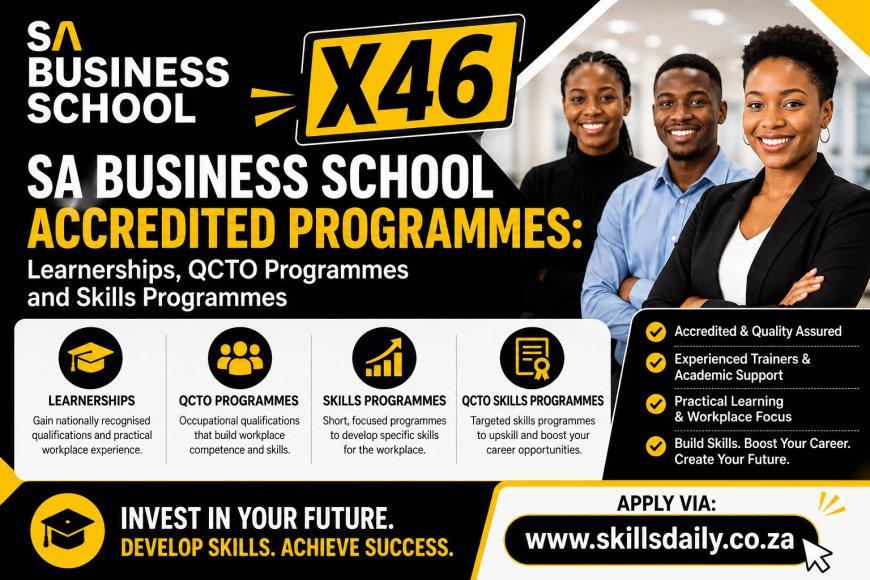
SA Business School Accredited Programmes: Learnerships, QCTO Programmes and Skills Programmes
In South Africa’s competitive employment and business environment, recognised training and practical skills development can play an important role in preparing people for the workplace. SA Business School (SABS) provides a range of accredited learning solutions, including learnerships, QCTO programmes, skills programmes and QCTO skills programmes designed to support both individual learners and organisations.
SA Business School describes itself as an accredited training provider offering learning solutions across areas such as management, business and commerce, information technology and learnerships. The organisation says its programmes are supported by academic guidance, study materials, experienced trainers and practical workshops.
SA Business School Learnership Programmes
Learnerships combine structured theoretical learning with practical workplace experience and lead to qualifications registered on the National Qualifications Framework (NQF). SA Business School explains that learnerships can help bridge the gap between education and the skills required by employers.
Its current learnership portfolio includes programmes in Management & Operations, IT, and Wholesale & Retail. Examples include:
-
National Certificate: Business Administration – NQF Level 2
-
National Certificate: Business Administration – NQF Level 3
-
National Certificate: Contact Centre and BPO – NQF Level 3
-
FETC: Business Administration Services – NQF Level 4
-
FETC: Generic Management – NQF Level 4
-
National Certificate: Generic Management – NQF Level 5
-
National Certificate: End User Computing – NQF Level 3
-
National Certificate: Systems Support – NQF Level 5
-
National Certificate: Wholesale & Retail Distribution – NQF Level 2
-
National Certificate: Wholesale & Retail Operations – NQF Level 3
-
National Certificate: Wholesale & Retail Operations Supervision – NQF Level 4
These programmes can be particularly relevant to people seeking to develop skills in administration, management, IT, contact centres and retail operations.
Academic Support for Learners
SA Business School states that its learnerships are supported by study guides, experienced industry and academic experts, and workshops. Its learning materials can include learner guidebooks or Portfolios of Evidence (POEs) containing prescribed readings, assignments, assessments and tutorials.
This type of support can be valuable to learners who need guidance throughout their programme rather than simply completing a once-off training course.
QCTO Programmes
SA Business School also offers QCTO occupational programmes aimed at developing occupational knowledge, practical skills and workplace competence.
Its current QCTO portfolio includes programmes in Management & Operations, Wholesale & Retail, and Real Estate.
Management and Operations
The available programmes include:
-
Occupational Certificate: Contact Centre Manager – NQF Level 5, SAQA ID 99687
-
Occupational Certificate: Management Assistant – NQF Level 5, SAQA ID 101876
-
Occupational Certificate: Office Administrator – NQF Level 5, SAQA ID 102161
-
Occupational Certificate: Office Supervisor – NQF Level 5, SAQA ID 118740
-
Occupational Certificate: Project Manager – NQF Level 5, SAQA ID 101869
Wholesale and Retail
Programmes include:
-
Occupational Certificate: Retail Supervisor – NQF Level 4, SAQA ID 99573
-
Occupational Certificate: Retail Chain Store Manager – NQF Level 5, SAQA ID 103150
-
Occupational Certificate: Retail Manager – NQF Level 6, SAQA ID 91789
Real Estate
The portfolio also includes:
-
Occupational Certificate: Real Estate Agent – NQF Level 4, SAQA ID 118714.
These programmes provide options for learners and employees who want to develop occupational skills in areas such as office administration, project management, contact centre management, retail management and real estate.
Skills Programmes
For organisations that need shorter, targeted training interventions, SA Business School offers a broad selection of skills programmes.
The school describes skills programmes as focused interventions that can address specific skills gaps without requiring learners to complete an entire qualification. These programmes can consist of selected unit standards from larger qualifications and can provide credits towards a qualification.
Its current skills programme portfolio covers several categories.
Management
Programmes include:
-
Empowering Leaders
-
Management Development Programme
-
New Manager Development Programme
-
Organisational & Prioritisation Skills
Employee and Performance Development
Options include:
-
Emotional Intelligence
-
Managing a Team
-
Stress & Time Management
General Management Competencies
Programmes include:
-
Change Management
-
Conflict Management
-
Customer Service Excellence
-
Finance for Non-Financial Managers
-
Problem Solving & Decision Making
-
Team Dynamics
Communication Skills
Learners can also access:
-
Business Communication
-
Communication Skills
-
Presenting With Impact
Professional Development
The portfolio includes programmes such as:
-
Business Etiquette & Professional Conduct in the Workplace
-
Business Writing Skills
-
Negotiation Skills
-
Report Writing Skills
-
Supervisory Skills
-
Introduction to Excel
-
Intermediate Excel
-
Advanced Excel
The school notes that some of these programmes are based on unit standards, while certain Excel and other courses are listed as non-accredited. Applicants should therefore confirm the accreditation status of the specific programme they are interested in.
QCTO Skills Programmes
In addition to its broader skills programme offering, SA Business School provides QCTO Skills Programmes for focused upskilling.
The current listed options include:
-
Workplace Preparation – SP-201201, NQF Level 2
-
Workplace Essential Skills – SP-211009, NQF Level 4
-
Conflict Management – SP-210409, NQF Level 5
These shorter programmes can be useful where an organisation needs to address a particular workplace competency without putting employees through a full occupational qualification.
Why Skills Programmes Can Be Useful
Short skills programmes can provide a practical way of addressing specific workplace skills gaps. SA Business School highlights benefits such as faster implementation, a choice of subject areas, development of both hard and soft skills, and the ability to complement existing training initiatives.
For example, an organisation may need to improve its employees' customer service, conflict management, communication, leadership or team-management skills. Rather than enrolling every employee in a full qualification, a targeted skills programme can focus directly on the identified competency.
Learnerships vs Skills Programmes
The two options serve different purposes.
Learnerships are broader, structured learning programmes that combine theoretical learning with workplace experience and lead to a full NQF-registered qualification. They are generally suited to longer-term talent development and occupational preparation.
Skills programmes, on the other hand, are shorter and more focused. They target specific competencies and can be used to close particular skills gaps or complement a broader learning programme.
This means organisations can potentially use a combination of learnerships and skills programmes as part of a wider workforce development strategy.
Supporting South Africa's Skills Development
SA Business School positions its training solutions as part of a broader effort to address South Africa's skills gap. The organisation says it has trained more than 5,000 previously disadvantaged individuals and offers SETA-accredited training.
The school also highlights the connection between skills development and B-BBEE, with skills development being an important component of the B-BBEE framework. Businesses can use structured training interventions to develop their employees while pursuing their broader transformation and workforce-development objectives.
However, companies should confirm the specific B-BBEE treatment, accreditation requirements and qualifying criteria for each programme with their verification agency or relevant authority before making decisions based on scorecard benefits.
Who Can Benefit From These Programmes?
SA Business School's programme portfolio may be relevant to:
-
Young people seeking recognised qualifications and workplace skills.
-
Job seekers looking to strengthen their employability.
-
Employees who want to advance their careers.
-
Supervisors and managers developing leadership skills.
-
Businesses looking to close specific workplace skills gaps.
-
Organisations developing future talent pipelines.
-
Employers implementing structured skills development initiatives.
How to Find the Right Programme
The best programme depends on the learner's career goals and, for employers, the organisation's skills requirements.
Someone interested in office administration, for example, could consider a Business Administration learnership or the Occupational Certificate: Office Administrator. A person interested in retail management could explore the Wholesale & Retail learnerships or QCTO retail programmes.
For shorter interventions, programmes covering communication, customer service, conflict management, leadership, Excel or supervisory skills may be more appropriate.
Applicants should check the latest entry requirements, programme duration, accreditation status, costs, funding availability and application process directly with SA Business School before enrolling.
Final Thoughts
SA Business School offers a diverse portfolio of learning opportunities, ranging from NQF-registered learnerships and QCTO occupational qualifications to focused skills programmes and QCTO skills programmes.
For individuals, these programmes can provide opportunities to gain recognised knowledge and workplace competencies. For employers, they can form part of a broader strategy for employee development, talent pipelines and skills-gap management.
With programmes covering business administration, management, IT, contact centres, wholesale and retail, office administration, project management and other professional skills, SA Business School provides several pathways for people and organisations seeking structured skills development.
Apply or Enquire
Prospective learners and employers should visit the official SA Business School website for current programme availability, requirements and application information.
SA Business School – Learnerships
SA Business School – QCTO Programmes
What's Your Reaction?
 Like
0
Like
0
 Dislike
0
Dislike
0
 Love
0
Love
0
 Funny
0
Funny
0
 Angry
0
Angry
0
 Sad
0
Sad
0
 Wow
0
Wow
0