






















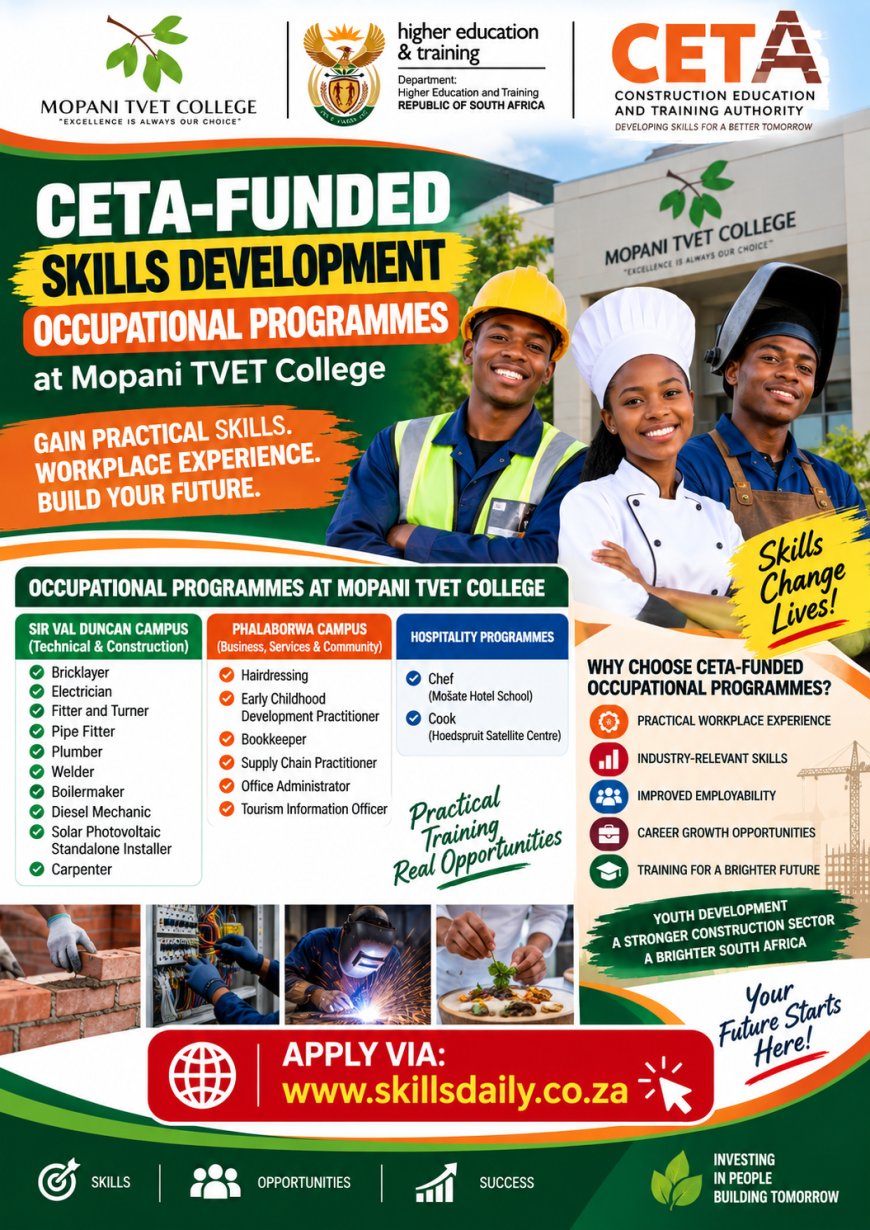
CETA-Funded Skills Development Occupational Programmes at Mopani TVET College

CETA-Funded Work Integrated Learning and Occupational Programmes at Mopani TVET College
Young South Africans looking to build practical, industry-relevant skills can explore the Work Integrated Learning (WIL) and Occupational Programme opportunities offered through Mopani TVET College.
Mopani TVET College has expanded its occupational training offering to include a range of programmes linked to technical trades, construction, engineering, business, hospitality and other occupational fields. The College also works with Sector Education and Training Authorities (SETAs) to facilitate experiential learning and in-service training, helping students gain workplace exposure alongside their studies.
For learners interested in construction and technical careers, the Construction Education and Training Authority (CETA) is particularly relevant. CETA funds skills-development interventions that include TVET placements and Work Integrated Learning, with the aim of helping learners gain practical experience in the construction sector.
What Is Work Integrated Learning?
Work Integrated Learning is designed to bridge the gap between classroom theory and the workplace.
CETA describes WIL as an important part of training and development because practical workplace experience helps learners become more skilled, knowledgeable, ethical and confident. Its WIL opportunities cover areas including building construction, built-environment professions, electrical and road construction, civil construction and material manufacturing.
For TVET students, CETA's TVET placement programme provides practical experience for students for 12 months within the construction sector.
This type of experience can be particularly valuable for students who need workplace exposure before entering permanent employment.
CETA and Skills Development
The Construction Education and Training Authority (CETA) is responsible for supporting skills development within South Africa's construction sector.
CETA states that its purpose includes addressing skills gaps and developing education and training programmes that respond to the needs of the construction industry. It funds a range of programmes at public education and training institutions, including TVET colleges.
CETA's Projects Division identifies and implements funded interventions through discretionary grants. These include:
- Work Integrated Learning
- TVET student placements
- Apprenticeships
- Learnerships
- Internships
- Graduate placements
- Bursaries
- Recognition of Prior Learning
- Short skills programmes
- Skills development centres
The authority also identifies youth, women, people with disabilities, military veterans and rural populations among its designated priority groups for discretionary grant allocations.
Mopani TVET College Occupational Programmes
Mopani TVET College currently lists 18 occupational programmes across its campuses and satellite centres.
The occupational offering is particularly relevant to students looking for practical career pathways.
Occupational Programmes at Sir Val Duncan Campus
The Sir Val Duncan Campus offers several technical and construction-related occupational qualifications, including:
- Occupational Certificate: Bricklayer
- Occupational Certificate: Electrician
- Occupational Certificate: Fitter and Turner
- Occupational Certificate: Pipe Fitter
- Occupational Certificate: Plumber
- Occupational Certificate: Welder
- Occupational Certificate: Boilermaker
- Occupational Certificate: Diesel Mechanic
- Occupational Certificate: Solar Photovoltaic Standalone Installer
- Occupational Certificate: Carpenter
These programmes can provide pathways into occupations across the construction, engineering, manufacturing, energy and related technical sectors.
Occupational Programmes at Phalaborwa Campus
The Phalaborwa Campus offers occupational qualifications in areas such as:
- Hairdressing
- Early Childhood Development Practitioner
- Bookkeeper
- Supply Chain Practitioner
- Office Administrator
- Tourism Information Officer
This gives students opportunities beyond traditional engineering and construction fields.
Hospitality Occupational Programmes
Students interested in hospitality can also pursue occupational qualifications through Mošate Hotel School and the Hoedspruit Satellite Centre.
The programmes include:
- Occupational Certificate: Chef
- Occupational Certificate: Cook
Both locations therefore provide opportunities for learners interested in professional cooking and hospitality careers.
Construction-Focused Opportunities
For learners interested specifically in CETA-supported workplace learning, the technical occupational programmes at Mopani are especially relevant.
CETA's mandate focuses on developing skills required by the construction sector, while its WIL and TVET placement initiatives are designed to provide practical experience in areas such as building construction, electrical construction, civil construction and other related fields.
Mopani's occupational offering includes several programmes that align with these broad construction and technical areas, including Bricklayer, Electrician, Fitter and Turner, Pipe Fitter, Plumber, Welder, Boilermaker, Carpenter and Solar Photovoltaic Standalone Installer.
Why Work Integrated Learning Matters
Completing a qualification is an important achievement, but employers often look for applicants who can demonstrate that they understand how their skills are applied in a real workplace.
WIL can help students develop:
Practical Experience
Learners have an opportunity to apply concepts learned during training to real workplace situations.
Technical Skills
Students can strengthen occupational competencies through practical exposure.
Workplace Readiness
Working in an actual organisation can help learners understand workplace expectations, procedures, safety requirements and professional conduct.
Communication and Teamwork
Workplace environments require employees to communicate effectively with colleagues, supervisors, customers and other stakeholders.
Improved Employability
Practical experience can strengthen a graduate's CV and demonstrate that the learner has had exposure to the workplace.
CETA specifically describes WIL as an opportunity for learners to develop the skills, knowledge, confidence and ethical awareness needed in their chosen fields.
Mopani's Industry Partnerships
Mopani TVET College places significant emphasis on partnerships with employers and industry.
The College's website currently reports 48 employer/industry partners, along with 301 student placements for 2026. It also reports 18 occupational programmes.
In June 2026, Mopani hosted a Partnership Gala Dinner bringing together industry representatives, employers, SETAs, government stakeholders and other partners. The College said these partnerships are important for expanding workplace-based learning opportunities and ensuring graduates develop the knowledge and practical experience required by industry.
This industry connection is important because occupational education works best when training is linked to actual workplace requirements.
Occupational Training at Mopani
Mopani describes its teaching approach as vocational and skills-based, combining:
- Theory through classroom learning
- Practical training through workshops, laboratories and kitchens
- Workplace exposure through industry experience
The College says this model is intended to prepare students directly for employment and produce work-ready graduates.
The College's occupational programmes therefore form part of a broader move towards practice-oriented education.
In April 2026, Mopani also hosted training for lecturers and facilitators involved in implementing occupational programmes. The College noted that occupational qualifications are guided by the Quality Council for Trades and Occupations (QCTO) and are intended to respond to labour-market and industry requirements.
Who Should Consider These Programmes?
Mopani's occupational and WIL pathways may be particularly suitable for people who prefer practical, career-focused learning.
They may appeal to:
- Young people interested in technical trades
- Students interested in construction careers
- Aspiring electricians and plumbers
- Future welders and boilermakers
- People interested in solar and renewable-energy installation
- Aspiring chefs and hospitality workers
- Students interested in administration, supply chain and bookkeeping
- Individuals looking to develop occupational skills
- TVET students who need workplace exposure
Admission requirements vary according to the qualification, so prospective students should check the specific programme requirements before applying.
Is CETA Funding Available for Every Mopani Programme?
It is important for applicants to understand that CETA does not fund every occupational programme at Mopani TVET College.
CETA's mandate is focused on the construction sector, and its funding is allocated to specific approved projects and interventions. CETA explains that it funds stakeholders within the construction sector to implement skills-development programmes rather than directly providing training to members of the public.
Therefore, applicants should not assume that every programme listed on Mopani's Occupational Programmes page is CETA-funded.
Instead, prospective learners should look for an official Mopani or CETA advertisement confirming the funding arrangement, programme, eligibility requirements, duration and application process.
How to Apply
Students interested in Mopani's Occupational Programmes should visit the College's official website and check the latest programme and application information.
Mopani's website currently lists its occupational programmes by campus and provides information about applications and admissions.
Official Mopani Occupational Programmes:
Mopani TVET College – Occupational Programmes
Official CETA Website:
Construction Education and Training Authority (CETA)
Applicants should always use the official advertisement for the particular funded opportunity and follow the stated application instructions.
Important Advice for Applicants
Before applying for a CETA-funded WIL or occupational opportunity, applicants should check:
- The exact programme name
- Admission requirements
- Whether the opportunity is currently funded
- Whether workplace placement is included
- Programme duration
- Campus/location
- Application closing date
- Required supporting documents
- Whether an allowance or stipend is specified
- The official organisation responsible for receiving applications
CETA also warns that it does not directly provide skills programmes to members of the public; funding is provided to stakeholders for implementation. Applicants should therefore be cautious of anyone claiming to offer a CETA programme directly while requesting inappropriate payments or personal information.
Mopani TVET College's Occupational Programmes and Work Integrated Learning opportunities provide an important pathway for South Africans who want to develop practical skills and prepare for the workplace.
The College offers occupational programmes ranging from Bricklaying, Electrical, Welding, Plumbing and Boilermaking to Solar Photovoltaic Installation, Carpentry, Hospitality, Hairdressing, Supply Chain and Office Administration.
For learners pursuing construction-related careers, CETA's WIL and TVET placement initiatives can provide valuable practical workplace exposure. CETA specifically supports TVET placements and WIL as part of its construction-sector skills-development interventions.
The combination of occupational training, practical learning and workplace exposure can help learners move from learning skills in the classroom to applying those skills in the real world.
Applicants should check Mopani TVET College and CETA's official websites regularly for confirmed funded opportunities, application dates and eligibility requirements.
What's Your Reaction?
 Like
1
Like
1
 Dislike
0
Dislike
0
 Love
1
Love
1
 Funny
0
Funny
0
 Angry
1
Angry
1
 Sad
0
Sad
0
 Wow
0
Wow
0