























X12 CPT Learnership Programmes: Building Manufacturing and Production Skills in South Africa
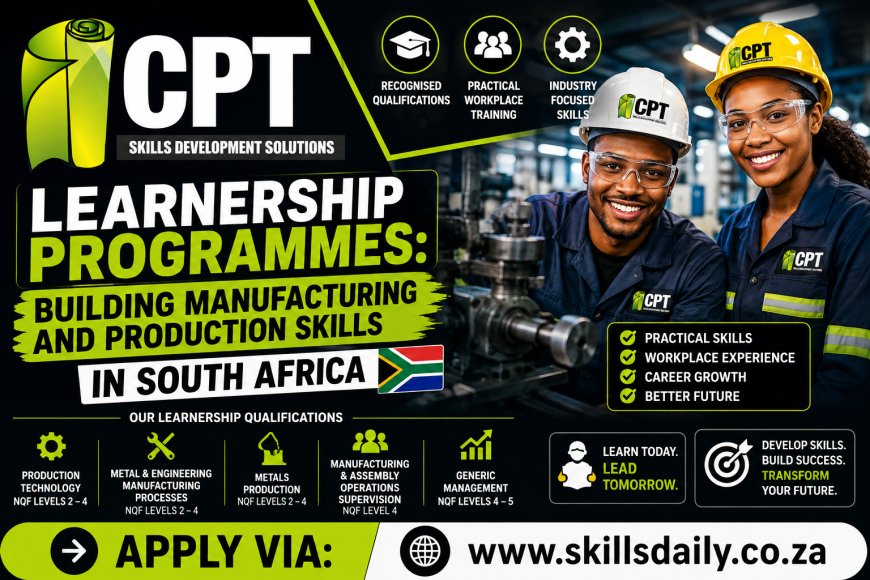
X12 College of Production Technology Learnership Programmes: Building Manufacturing and Production Skills in South Africa
South Africa’s manufacturing, engineering and production sectors require workers with practical technical knowledge, workplace competence and an understanding of modern production systems. For companies looking to strengthen their workforce, learnerships can provide a structured way to develop employees while working towards recognised qualifications.
The College of Production Technology (CPT) is an accredited training provider specialising in vocational education and workplace skills development. CPT has been operating since 2000 and offers learnerships and skills programmes across production, manufacturing, engineering, technology and related fields.
Its manufacturing and production learnerships are particularly focused on developing practical capabilities that can be applied in real workplace environments.
What Are CPT Manufacturing and Production Learnerships?
CPT's manufacturing and production learnerships are designed to complement the skills required in manufacturing, engineering and technology environments. The programmes combine theoretical learning with practical workplace application, helping learners develop knowledge and competencies relevant to production operations.
The programmes are aligned with MerSETA, with the qualifications on CPT's manufacturing and production learnership page identifying MerSETA as the primary ETQA and listing registered qualifications at different NQF levels.
CPT describes its workplace learnerships as practical programmes intended to build industry-ready skills while enabling employees to work towards recognised qualifications.
Manufacturing and Production Qualifications
CPT's manufacturing and production portfolio includes qualifications covering production technology, metal and engineering manufacturing processes, metals production and manufacturing supervision.
The programmes listed by CPT include:
-
National Certificate: Metal and Engineering Manufacturing Processes – NQF Level 2
-
National Certificate: Metal and Engineering Manufacturing Processes – NQF Level 3
-
FETC: Metal and Engineering Manufacturing Processes – NQF Level 4
-
National Certificate: Production Technology – NQF Level 2
-
National Certificate: Production Technology – NQF Level 3
-
FETC: Production Technology – NQF Level 4
-
National Certificate: Metals Production (Engineering & Manufacturing) – NQF Level 2
-
National Certificate: Metals Production (Engineering & Manufacturing) – NQF Level 3
-
FETC: Metals Production (Engineering & Manufacturing) – NQF Level 4
-
FETC: Generic Management (Planning & Scheduling Techniques) – NQF Level 4
-
FETC: Generic Management (Manufacturing Control) – NQF Level 4
-
NC: Generic Management (Generic Manufacturing) – NQF Level 5
The exact availability of qualifications and enrolment periods should be confirmed directly with CPT before applying.
Production Technology Learnerships
One of CPT's key pathways is Production Technology, which progresses from NQF Level 2 through NQF Level 4.
National Certificate: Production Technology NQF Level 2
The NQF Level 2 Production Technology qualification provides learners with foundational vocational knowledge and skills for manufacturing, engineering and technology environments.
The qualification covers areas including production processes, workplace safety, production terminology, organisational processes and quality standards. Learners can also develop the ability to communicate production-related information and contribute to maintaining safe and effective production environments.
CPT lists this qualification as SAQA ID 58781, with a minimum of 125 credits and MerSETA as the primary ETQA.
National Certificate: Production Technology NQF Level 3
The NQF Level 3 qualification builds on foundational production knowledge.
Learners develop competencies related to production maintenance, production systems, planning and scheduling, quality control and quality assurance. Effective teamwork and communication are also important components of the qualification.
CPT lists the qualification as SAQA ID 58785, with 120 credits, at NQF Level 3.
FETC: Production Technology NQF Level 4
The NQF Level 4 Production Technology qualification represents the third level in CPT's three-stage Production Technology pathway.
At this level, learners develop skills in measuring and improving productivity, contributing to budgeting processes, solving operational problems and supporting quality assurance and quality control procedures.
CPT lists the qualification as SAQA ID 58779, NQF Level 4, with a minimum of 143 credits.
Metal and Engineering Manufacturing Learnerships
CPT also provides qualifications specifically focused on metal and engineering manufacturing processes.
The NQF Level 2 qualification is intended for individuals working in, or seeking to work in, metal and engineering manufacturing environments. The programme develops knowledge and skills relevant to manufacturing processes and workplace operations.
At NQF Level 3, learners develop competence in the operation and monitoring of machinery used in metal and engineering manufacturing processes. The qualification recognises skills associated with operating and monitoring manufacturing machinery, assembling components and working with manufacturing processes.
The NQF Level 4 qualification extends these capabilities further, including areas such as engineering drawings, first-line maintenance, materials handling and the setting up of production or manufacturing machinery.
Metals Production Qualifications
CPT's portfolio also includes qualifications specifically designed for the metals production environment.
The NQF Level 2 qualification can prepare learners to operate and maintain process equipment within areas such as extracting, melting, refining, casting, rolling, shearing and forging. The qualification also covers quality procedures, health and safety, environmental procedures, equipment preparation and first-line maintenance.
The NQF Level 3 qualification develops further capabilities in operating and maintaining production equipment and contributing to efficient production processes.
At NQF Level 4, learners can develop the ability to control and coordinate larger production processes within metals-production environments. CPT explains that this level can involve significant responsibility because errors in large-scale production processes can have substantial operational and financial consequences.
Manufacturing and Assembly Operations Supervision
For employees moving towards supervisory responsibilities, CPT offers the FETC: Manufacturing & Assembly Operations Supervision NQF Level 4.
The qualification is designed to develop frontline supervisory capability within manufacturing, engineering and production environments. Learners develop skills related to managing teams, coordinating workflow, allocating resources, monitoring production targets and maintaining safety, quality and efficiency.
CPT lists this qualification as SAQA ID 48915, NQF Level 4, with 150 credits, and MerSETA as the primary ETQA.
This pathway can be particularly relevant to employees who are preparing to take on greater responsibility on the production floor.
What Skills Can Learners Develop?
The manufacturing and production programmes cover a wide range of workplace competencies.
Depending on the qualification, learners can develop skills in:
-
Production processes and systems
-
Production planning and scheduling
-
Quality control and quality assurance
-
Workplace health and safety
-
Environmental procedures
-
Productivity measurement
-
Production maintenance
-
Manufacturing machinery operation
-
Materials handling
-
Problem-solving
-
Team communication
-
Resource allocation
-
Production supervision
-
Process improvement
These competencies are designed to connect learning with practical manufacturing and production environments.
Practical Workplace Learning
One of the major features of CPT's approach is the emphasis on workplace application.
CPT describes its learnerships as programmes that combine structured learning with real workplace application. This approach allows learners to develop practical capabilities that can be applied within production and manufacturing operations.
The organisation's prospectus also describes its learnerships as providing hands-on training and experience with production technologies, while introducing learners to industry best practices and the practical skills required in the workplace.
Benefits for Employees
Manufacturing learnerships can help employees build formal qualifications while strengthening their existing workplace capabilities.
For workers already employed in manufacturing, engineering or production, a learnership can provide a structured development pathway that connects formal learning with their day-to-day responsibilities.
At higher NQF levels, the qualifications can also support progression into roles involving greater technical, operational or supervisory responsibility.
Benefits for Employers
Learnerships can form part of an organisation's broader workforce-development strategy.
CPT states that its programmes are designed to help businesses develop competent and productive teams aligned with industry standards and organisational objectives.
The company's skills programmes are similarly focused on practical competence, compliance, productivity, supervisory capability and process consistency within manufacturing and production environments.
For employers, this means training can be connected directly to workplace requirements rather than being treated as classroom learning alone.
Who Can Benefit From CPT's Programmes?
CPT's manufacturing and production programmes are particularly relevant to organisations and employees operating in:
-
Manufacturing
-
Engineering
-
Production
-
Metal processing
-
Automotive-related environments
-
Assembly operations
-
Industrial operations
-
Metals production
The qualifications cater for different levels of responsibility, from foundational production skills through to production technology and supervisory capabilities.
CPT's Experience in Skills Development
The College of Production Technology states that it has more than 23 years of experience in vocational training and skills development. Its history dates back to 2000, when the organisation was established in response to the need for industry-specific technical training in South Africa.
CPT says it now offers learnerships from NQF Levels 1 to 5 across a variety of industries and holds several accreditations and industry affiliations, including MerSETA accreditation.
Learnerships and the Future of Manufacturing Skills
As manufacturing environments become increasingly focused on productivity, quality, safety and technological capability, employees need more than theoretical knowledge.
Practical skills development can help workers understand production systems, operate equipment safely, identify problems, contribute to quality processes and improve workplace performance.
CPT's manufacturing and production learnerships are designed around these requirements, with qualifications progressing from foundational production capabilities to more advanced technical and supervisory competencies.
How to Find Out More
Individuals and organisations interested in the College of Production Technology's manufacturing and production learnerships can view the programme details directly on CPT's website.
Official learnership information:
College of Production Technology – Manufacturing and Production Learnerships
CPT lists training locations including Johannesburg, Durban and Port Elizabeth (PE) and provides contact information for enquiries.
Prospective learners and employers should confirm the latest qualification availability, entry requirements, enrolment dates, funding arrangements and other programme conditions directly with CPT before applying.
The College of Production Technology's manufacturing and production learnerships provide structured pathways for developing practical skills in production, engineering, manufacturing and related industrial environments.
With programmes ranging from NQF Level 2 to NQF Level 5, the portfolio includes Production Technology, Metal and Engineering Manufacturing Processes, Metals Production, Manufacturing and Assembly Operations Supervision and related management pathways.
For employees and organisations seeking to strengthen technical capability, improve workplace performance and develop a more skilled production workforce, CPT's learnership programmes offer a workplace-focused approach to skills development.
Important: Qualification availability, enrolment extensions and programme requirements can change. Always verify the current information with CPT before applying.
X100 Siyanqoba Skills Development Learnership Programmes: Building Skills for the Future
X12 SETA-Accredited Learnerships and X4 Skills Development Programmes at Progression
X16 Training Excellence Learnerships and Skills Development Programmes in South Africa
What's Your Reaction?
 Like
0
 Dislike
0
 Love
0
 Funny
0
 Angry
0
 Sad
0
 Wow
0