
















Ekurhuleni West TVET College Work-Integrated Learning Programmes: Occupational Programmes for Practical Career Skills
Ekurhuleni West TVET College Work-Integrated Learning Programmes: Occupational Programmes for Practical Career Skills
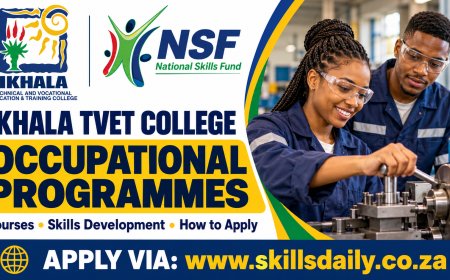
For students looking for career-focused education that combines classroom learning with practical workplace experience, Ekurhuleni West TVET College (EWC) offers a range of occupational programmes designed around technical and vocational skills.
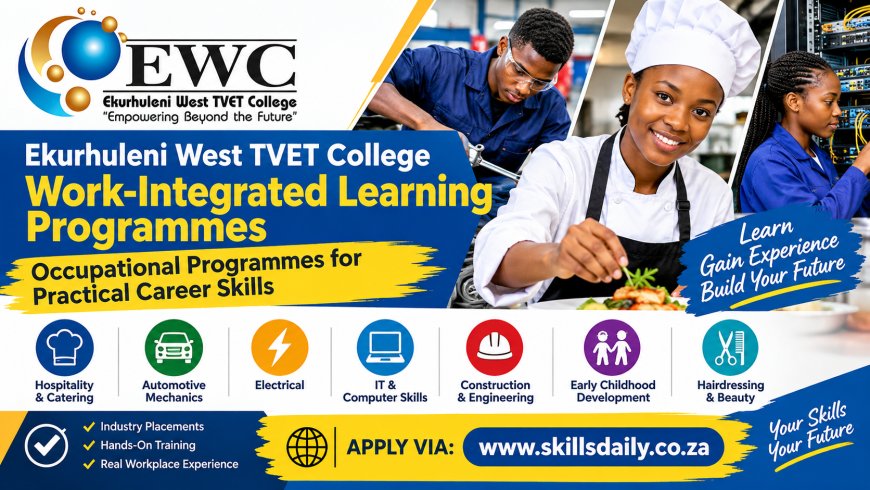
EWC’s programme portfolio includes National Certificate Vocational (NCV), NATED, skills and occupational programmes. Its occupational offering is particularly relevant to learners who want to develop practical competencies in areas such as electrical work, automotive mechanics, construction, information technology, hospitality and early childhood development.
Official programme information:
Ekurhuleni West TVET College – Programmes
What Are Occupational Programmes?
Occupational programmes are designed around specific occupations and workplace competencies. Rather than focusing only on classroom theory, these programmes are intended to develop the practical knowledge and skills needed in particular industries.
This makes occupational training relevant to people who want to pursue careers in technical trades, services, technology and other occupational fields.
EWC's 2024 Annual Report highlights the college's emphasis on Work-Integrated Learning (WIL) and industry placement, reporting that students in vocational and occupational programmes were placed with employers for practical experience. The college reported workplace placements for NC(V) students, Report 191/National Diploma students and apprentices through industry and SETA-supported initiatives.
Occupational Programmes Available at EWC
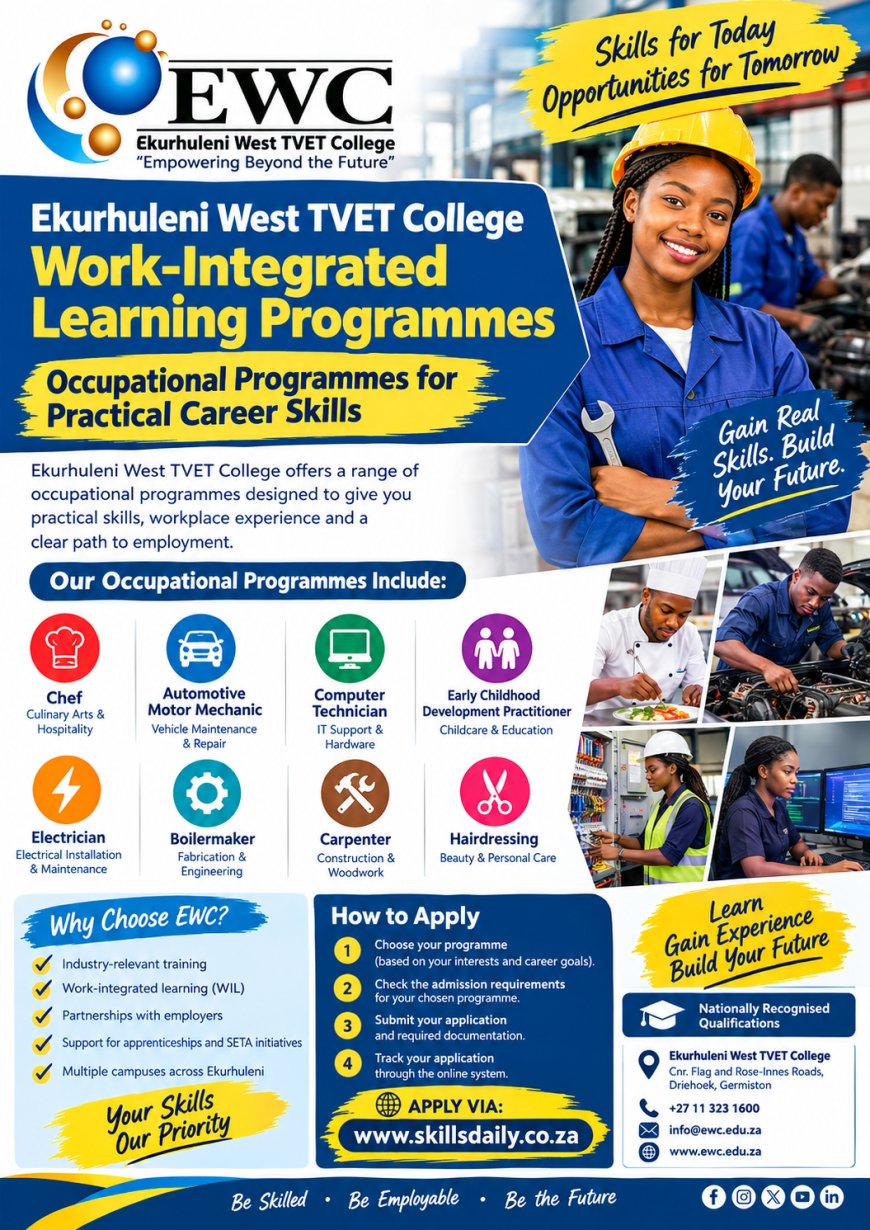
According to EWC's current 2026 fee information, the college lists several occupational programmes for 2026. These include:
1. Occupational Certificate: Chef
The Chef programme is suited to learners interested in professional food preparation and the hospitality industry.
EWC lists the Chef qualification across Year 1, Year 2 and Year 3, with a 2026 listed amount of R16,123 per year.
2. Occupational Certificate: Automotive Motor Mechanic
Learners interested in vehicle maintenance and automotive repair can consider the Occupational Certificate: Automotive Motor Mechanic.
The programme is listed over three years, with EWC's 2026 fee information showing R10,738 per year.
3. Occupational Certificate: Computer Technician
The Computer Technician programme provides an option for learners interested in computer hardware and technical support.
EWC lists the programme for Year 1 and Year 2, with 2026 amounts of R12,596 for Year 1 and R10,738 for Year 2.
4. Occupational Certificate: Early Childhood Development Practitioner
For people interested in working with young children, EWC lists an Occupational Certificate: Early Childhood Development Practitioner at NQF Level 4.
The 2026 fee information lists an amount of R10,181 for the programme.
5. Occupational Certificate: Electrician
Electrical skills remain an important part of technical and vocational education. EWC lists an Occupational Certificate: Electrician over three years.
The 2026 listed amount is R13,911 per year.
6. Occupational Certificate: Boilermaker
The Boilermaker programme is aimed at learners interested in fabrication, engineering and industrial construction environments.
EWC lists the programme across three years, with a 2026 listed amount of R14,404 per year.
7. Occupational Certificate: Carpenter
Carpentry provides another practical trade pathway, with training focused on skills associated with construction and woodworking.
EWC lists the Carpenter programme across Year 1, Year 2 and Year 3, at R12,407 per year according to its 2026 fee schedule.
Hairdressing Occupational Programme
EWC also lists a QCTO qualification in Hairdressing. The 2026 information covers three stages:
- Year 1 – National Certificate Level 2
- Year 2 – National Certificate Level 3
- Year 3 – National Certificate Level 4
The college's published information includes practical assessment requirements and, for the final stage, requirements relating to formal and industry hours and a completed Portfolio of Evidence (PoE).
This illustrates an important feature of occupational education: completing classroom activities alone may not be sufficient where a qualification requires practical or industry-based evidence.
Work-Integrated Learning and Industry Experience
One of the important aspects of EWC's occupational and vocational training is the connection between college-based education and the workplace.
EWC's 2024 Annual Report states that the college placed students in industry for practical experience. It reported that 57 NC(V) students requiring workplace exposure and 238 Report 191/National Diploma students were successfully placed with host employers during 2024. The report also describes apprenticeship placements supported through SETA-funded initiatives.
The college reported placements involving occupations such as:
- Electrical
- Welding
- Automotive Mechanics
- Mechanical Fitting
- Millwright
- Other artisan-related trades
These industry partnerships allow learners and apprentices to gain exposure to actual workplace environments while completing required practical components.
Occupational Programmes vs NC(V) and NATED Programmes
Students sometimes confuse occupational programmes with EWC's other programme categories.
NC(V) programmes are three-year vocational qualifications covering NQF Levels 2–4. EWC describes them as combining theoretical and practical experience in a chosen vocational field.
NATED/Report 191 programmes include engineering and business studies. EWC explains that N4–N6 studies can lead towards a National Diploma when the required practical workplace component is completed.
Occupational programmes, meanwhile, are structured around particular occupations and workplace competencies, making them an option for learners who want a more occupation-specific training pathway.
EWC has also indicated that it is expanding its occupational programme portfolio. Its 2025/26 Annual Performance Plan refers to accreditation of new occupational programmes, including robotics and welding, reflecting an ongoing development of occupational skills offerings.
Who Should Consider an Occupational Programme?
EWC occupational programmes may be relevant to learners who:
- Prefer practical learning alongside theory
- Want to develop skills for a specific occupation
- Are interested in artisan or technical careers
- Want exposure to workplace environments
- Are considering careers in automotive, electrical, construction, IT, hospitality or related fields
- Want to develop occupational skills rather than pursuing a conventional academic degree
The right programme depends on a learner's previous education, interests, career objectives and the admission requirements of the specific qualification.
EWC Campuses and Programme Availability
Programme availability varies by campus and qualification. EWC's broader programme catalogue lists different programmes across campuses including Alberton, Boksburg, Germiston, Kathorus, Kempton Park and Tembisa.
Applicants should therefore check the individual programme information before applying rather than assuming that every programme is offered at every campus.
2026 Occupational Programme Fees
EWC's published 2026 information provides the following listed amounts for several occupational programmes:
| Occupational Programme | 2026 Listed Amount |
|---|---|
| Chef – Year 1 | R16,123 |
| Chef – Year 2 | R16,123 |
| Chef – Year 3 | R16,123 |
| Automotive Motor Mechanic – Year 1 | R10,738 |
| Automotive Motor Mechanic – Year 2 | R10,738 |
| Automotive Motor Mechanic – Year 3 | R10,738 |
| Computer Technician – Year 1 | R12,596 |
| Computer Technician – Year 2 | R10,738 |
| Early Childhood Development Practitioner | R10,181 |
| Electrician – Year 1 | R13,911 |
| Electrician – Year 2 | R13,911 |
| Electrician – Year 3 | R13,911 |
| Boilermaker – Year 1 | R14,404 |
| Boilermaker – Year 2 | R14,404 |
| Boilermaker – Year 3 | R14,404 |
| Carpenter – Year 1 | R12,407 |
| Carpenter – Year 2 | R12,407 |
| Carpenter – Year 3 | R12,407 |
These are the amounts published by EWC for its 2026 occupational programmes; applicants should confirm the applicable fees, funding arrangements and admission requirements directly with the college before registration.
How to Apply
EWC's programme information outlines a four-step application process:
- Choose your programme according to your interests and career goals.
- Check the admission requirements for the programme.
- Submit your application and required documentation.
- Track your application through the college's online application system.
Because occupational programmes can have specific admission, practical-training and assessment requirements, prospective students should carefully review the requirements for their chosen programme.
Why Work-Integrated Training Matters
The transition from education to employment can be challenging when learners have little exposure to actual workplaces. Work-integrated learning helps connect what students learn in a training environment with the expectations of employers.
For technical occupations, this practical component can be particularly important because learners need opportunities to develop hands-on competencies, workplace behaviour, safety awareness and experience with real equipment and processes.
EWC's reported partnerships with employers and SETAs form part of this broader approach to practical training and occupational development.
Final Thoughts
Ekurhuleni West TVET College's occupational programmes provide occupation-focused training across areas such as chef training, automotive mechanics, computer technology, electrical work, boilermaking, carpentry, early childhood development and hairdressing.
The college's published information also demonstrates a focus on connecting vocational education with workplace exposure through industry placements, apprenticeships and partnerships.
For anyone considering an occupational qualification, the most important step is to identify the programme that matches their intended career and then verify the latest admission requirements, campus, fees, funding options and workplace requirements directly with EWC.
Apply and Find More Information
Ekurhuleni West TVET College – Official Programmes Page:
View EWC Programmes
EWC 2026 Fees and Occupational Programme Information:
View 2026 EWC Fees
EWC Contact: +27 11 323 1600
Email: info@ewc.edu.za
Address: Cnr. Flag and Rose-Innes Roads, Driehoek, Germiston.
What's Your Reaction?
 Like
7
 Dislike
0
 Love
2
 Funny
0
 Angry
1
 Sad
0
 Wow
3