






















SABS Youth Development Programmes (X25 Posts)
SABS: A Pillar of Quality, Safety, and Trust in South Africa
FOLLOW THE WHATSAPP CHANNEL FOR RECENT UPDATES
The South African Bureau of Standards (SABS) is the national standards authority of South Africa, mandated to develop, promote and maintain national technical standards, and provide services that help organisations and consumers ensure quality and safety in products and services. It was established in 1945 by the Standards Act and operates today under the updated Standards Act of 2008.
Over its long history, SABS has played a vital role in shaping South Africa’s economic development and consumer protection frameworks. It sets out rules and benchmarks that inform how products are made, tested, and certified — helping ensure that goods and services are safe, reliable, and fit for purpose before they reach consumers or global markets.

📌 What Does the SABS Do?
At its core, SABS has three interlinked mandates:
1. Developing National Standards (SANS)
SABS is responsible for creating and maintaining South African National Standards (SANS) — technical documents that define minimum requirements for products, systems, processes, and services.
These standards are developed through consensus among experts from industry, government, academia, consumer groups, and other stakeholders, ensuring they are relevant, robust, and globally aligned.
Standards cover a vast range of areas, from manufacturing and construction to food safety and information security. They help build consistency, compatibility, and innovation — all of which contribute to economic growth and consumer confidence.
2. Certification and Conformity Assessment
SABS doesn’t just write standards — it also tests and certifies products and systems against them. Certification gives organisations a trusted mark of approval that signifies compliance with safety, quality, and performance criteria.
This includes rigorous testing in specialised laboratories, audits of quality management systems, and verification of processes to ensure they meet specified standards. For businesses, achieving SABS certification can strengthen credibility and open doors to both local and international markets.
3. Support for Trade and Economic Growth
Standards are essential infrastructure for doing business — both domestically and internationally. By aligning South African standards with global best practices, SABS helps companies remain competitive and compliant with export requirements.
SABS also represents South Africa in international standardisation bodies such as the International Organization for Standardization (ISO) and the International Electrotechnical Commission (IEC), ensuring the country’s interests are part of global technical discussions and agreements.
📈 Why Standards Matter — For Industry, Government & Consumers
Standards may sound technical, but they play a tangible role in everyday life. Here’s how:
🏭 Industry Benefits
-
Streamlined product development and manufacturing processes
-
Easier market access and reduced trade barriers
-
Enhanced competitiveness through internationally recognised benchmarks
Standards provide the structure that enables businesses to innovate confidently and consistently.
🛡 Consumer Protection
-
Guarantees products meet minimum safety requirements
-
Reduces risks related to faulty or harmful goods
-
Improves consumer choice and confidence
When consumers see the SABS mark on a product, it signals reliability and conformity to established standards.
🏛 Government & Regulation
While standards themselves are usually voluntary, many laws and regulations reference specific SANS standards to define compliance requirements — especially in areas like construction, building codes, food safety, and electrical installations.
By doing so, governments create clearer legal benchmarks and make enforcement more effective, improving public safety and policy outcomes.
📚 A Legacy of Innovation and Influence
Since its founding in 1945, SABS has helped guide South Africa through major transitions — from the shift to the metric system to pioneering standards for new technologies.
As the country grows and industries evolve, SABS continues to shape how quality and safety are defined, ensuring that standards adapt to new challenges such as digital transformation, sustainability, and global trade dynamics.
🛠 The Future of Standards in South Africa
In an increasingly interconnected world, standardisation remains critical. SABS is positioned to:
-
Support innovation in emerging technologies
-
Strengthen frameworks for environmental sustainability
-
Expand services that help businesses improve competitiveness
-
Ensure consumer safety in an evolving marketplace
Whether it’s your smartphone, a safety helmet, or food products on shelves, the influence of SABS standards can be found in countless everyday items — forming the unseen backbone of quality and trust in South African society.
2026 SABS Youth Development Programme: Certification (12-Month Fixed-Term Contract)
Reference Number: SAB260218-8
Closing Date: 06 March 2026
Location: Pretoria, Gauteng, South Africa
Number of Positions: 7
Job Type: Internship Programme
Branch: Operations
Division: Certification Services
Department: Product Certification
Job Grade: A2
Minimum Qualification: Diploma or Advanced Certificate
About SABS
The South African Bureau of Standards (SABS) offers an inspiring and dynamic work environment that encourages growth, recognises potential, and promotes excellence. As a trusted provider of standardisation and business assurance solutions, SABS is committed to accountability, innovation, and inclusivity in the workplace.
In accordance with the Protection of Personal Information Act (POPIA), Act No. 4 of 2023, submission of your application constitutes consent for the collection, processing, and secure handling of your personal information for recruitment and selection purposes.
Programme Overview
SABS invites unemployed South African graduates to apply for its 2026 Youth Development Programme, a structured 12-month internship commencing in April 2026.
This initiative aims to provide meaningful workplace exposure, mentorship, and practical learning aligned with organisational objectives and national skills development priorities.
Successful candidates will receive a monthly stipend of R8,000 for the duration of the programme.
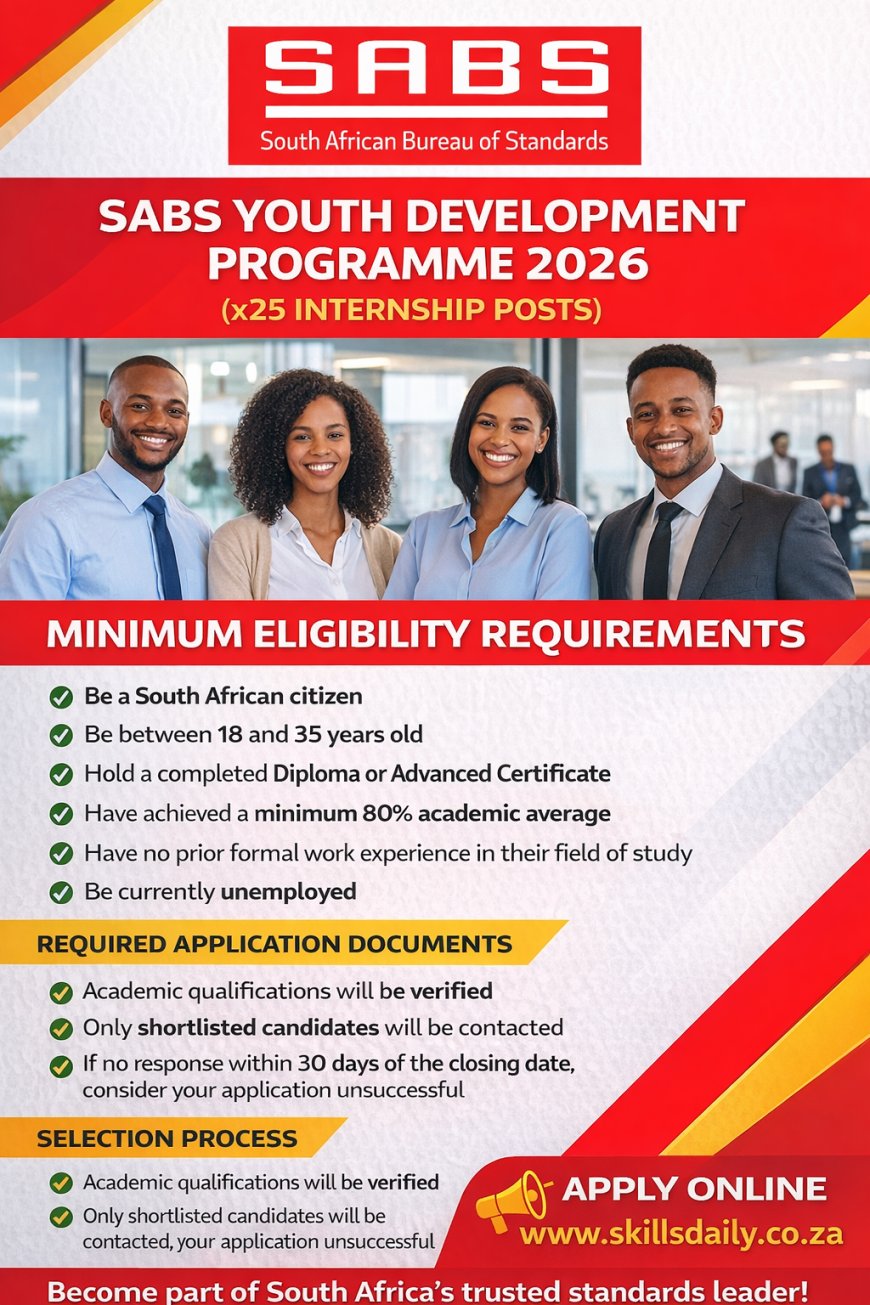
Minimum Eligibility Requirements
Applicants must:
-
Be a South African citizen
-
Be between 18 and 35 years old
-
Have completed a relevant Diploma or Advanced Certificate
-
Achieve a minimum academic average of 80% in the completed qualification
-
Have no prior formal work experience related to their field of study
-
Be currently unemployed
Required Application Documents
Candidates must submit:
-
A comprehensive CV
-
A certified copy of their South African ID
-
Certified copies of qualifications
Failure to submit all required documents will result in disqualification.
Selection Process
-
Academic qualifications will be verified
-
Only shortlisted candidates will be contacted
-
If no response is received within 30 days of the closing date, applicants should consider their application unsuccessful
Graduates living with disabilities are strongly encouraged to apply. Late applications will not be considered.
Successful applicants will be appointed on a fixed-term, one-year Development Programme contract.
Eligibility Disclaimer
Meeting the minimum requirements does not automatically guarantee selection. All applications will undergo a thorough verification process, including confirmation of citizenship, age, qualifications, academic performance, and employment status.
Applicants must provide accurate and truthful information. Any form of misrepresentation, omission, or false declaration may result in disqualification or termination from the programme if discovered at any stage.
SABS reserves the right to verify information with relevant institutions and authorities. Only candidates who fully meet the eligibility criteria and successfully complete the screening process will be considered.
Correspondence will be limited to shortlisted candidates only.
Duties and Responsibilities
The programme is structured to provide meaningful experiential learning through guided training and practical workplace exposure. Participants will:
-
Engage in structured training and development activities
-
Gain hands-on experience through rotational assignments
-
Support departmental projects, research, and administrative functions
-
Apply academic knowledge in a practical work environment
-
Demonstrate initiative, accountability, and a commitment to learning
-
Adhere to organisational policies, procedures, and professional standards
-
Submit progress reports and complete required assessments
-
Collaborate effectively with supervisors and team members
What's Your Reaction?
 Like
0
Like
0
 Dislike
0
Dislike
0
 Love
0
Love
0
 Funny
0
Funny
0
 Angry
1
Angry
1
 Sad
2
Sad
2
 Wow
1
Wow
1