
















Resolution Circle Work-Integrated Learning Programmes
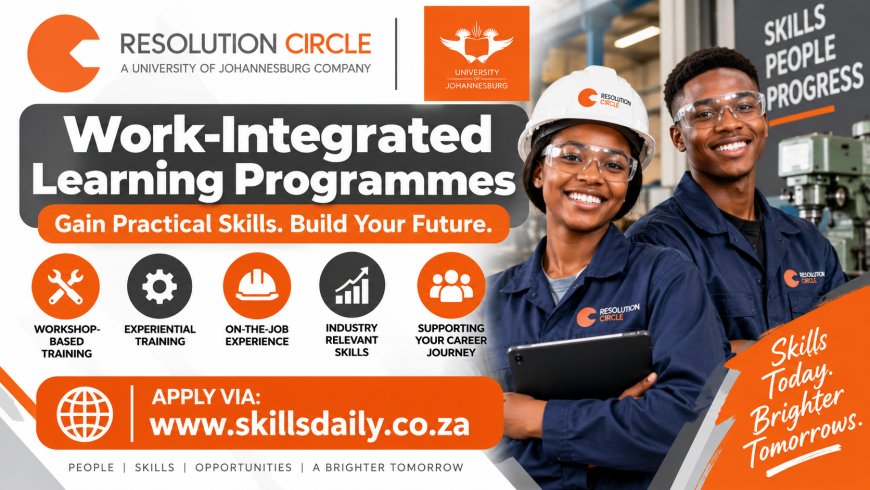
Resolution Circle Work-Integrated Learning Programmes for TVET Students
For many Technical and Vocational Education and Training (TVET) students, completing the practical component of a qualification is an important step towards obtaining the National N Diploma. Resolution Circle offers Work-Integrated Learning (WIL) programmes designed to help eligible TVET students gain practical technical experience while completing the workplace-related component of their studies.
The programmes combine workshop-based training, experiential learning and, where applicable, on-the-job workplace experience. They are adapted to the student's TVET qualification and area of specialisation.
What Is Resolution Circle?
Resolution Circle is a technical training provider associated with the University of Johannesburg (UJ). The organisation was established in 2012 after UJ identified a need to help engineering diploma students obtain opportunities to complete their Work-Integrated Learning requirements.
Over the years, Resolution Circle has expanded its technical training offering to include Work-Integrated Learning for TVET and University of Technology students, apprenticeships, skills programmes, short learning programmes and engineering candidacy programmes.
The organisation says it has provided P1 and P2 WIL to more than 2,000 undergraduate National Diploma Engineering students from six Universities of Technology over a seven-year period. It has also expanded its WIL offering to TVET National N Diploma students.
Work-Integrated Learning for TVET Students
Resolution Circle's TVET WIL programmes are specifically designed for TVET students with N6 who require the practical WIL component to obtain their National N Diploma. The programmes have a listed duration of 6 to 18 months, depending on the selected programme structure.
The training can be structured around:
- Workshop-based training
- Experiential training
- On-the-job experience
- A combination of the above
Students can therefore receive practical exposure that complements the theoretical knowledge gained during their TVET studies.
The 9 + 9 Programme
Resolution Circle's standard programme is known as the 9 + 9 programme.
It consists of:
9 months – Workshop-Based Training
followed by
9 months – Experiential Training
The organisation also offers a 6 + 6 + 6 programme, consisting of:
- 6 months workshop-based training
- 6 months experiential training
- 6 months on-the-job experience
The exact structure can be adapted to meet the requirements of the student's qualification and institution.
Workshop-Based Training
Workshop training gives students an opportunity to develop practical skills before progressing to experiential training.
The workshop component is structured according to the student's area of specialisation.
Electrical Engineering
For Electrical Engineering students, the nine-month workshop programme includes:
- Electrical workshop – 9 weeks
- Electronics workshop – 9 weeks
- Automation and Instrumentation – 9 weeks
- Carpentry – 3 weeks
- Fitting and Turning – 3 weeks
- Boilermaking and Welding – 3 weeks
Students therefore receive exposure to a range of complementary technical disciplines while maintaining a focus on their main field of study.
Mechanical Engineering
Mechanical Engineering students can receive training in:
- Carpentry workshop – 9 weeks
- Fitting and Turning – 9 weeks
- Boilermaking and Welding – 9 weeks
- Electrical workshop – 3 weeks
- Electronics workshop – 3 weeks
- Automation and Instrumentation – 3 weeks
This multidisciplinary approach gives students exposure to practical workshop environments and different technical applications.
Experiential Training
After workshop-based training, students can progress to experiential training where they apply their technical knowledge through practical engineering projects.
Electrical Engineering Experiential Training
The programme can include areas such as:
- Energy management – energy metering and recommendations for improved energy efficiency
- PV Solar – solar system design, installation and maintenance
- Electronics and repairs – cellphone and laptop repair and rework
- Maintenance – general electrical maintenance
- Automation and instrumentation – PLC and robotics
- PCB – PCB manufacturing
These activities allow students to move beyond classroom theory and develop practical problem-solving skills.
Mechanical Engineering Experiential Training
Mechanical Engineering students can gain exposure to areas including:
- CAD and 3D printing/additive manufacturing
- Reading and manufacturing drawings
- CAM and CNC workshop operations
- Operating CNC machinery
- Carpentry and CNC router operations
- General mechanical maintenance
This practical exposure can help students develop technical competence relevant to engineering workplaces.
On-the-Job Experience
Students following the 6 + 6 + 6 programme can complete an additional 24-week on-the-job experience phase.
During this component, students can be placed with host employers and gain experience in areas such as:
- Drawing and project offices
- Reading and interpreting basic engineering drawings
- Manufacturing and production
- Producing engineering parts using machinery
- Installation and maintenance
- Maintenance of machinery
This stage provides an opportunity for students to experience real workplace environments and apply the skills developed during their training.
Why WIL Is Important for TVET Students
Work-integrated learning is important because technical qualifications require more than theoretical knowledge. Students need opportunities to practise their skills, work with tools and equipment, solve practical problems and understand workplace expectations.
A strong WIL programme can help students:
- Develop practical technical skills
- Apply classroom knowledge
- Improve workplace readiness
- Gain experience with engineering equipment
- Develop problem-solving abilities
- Build confidence in professional environments
- Strengthen their employability
- Complete the practical component required for their qualification
Resolution Circle's experience also shows the importance of connecting education with industry. The organisation was originally established partly to address the shortage of WIL opportunities for engineering students.
Who Should Apply?
The programme is aimed at TVET students with N6 who require the WIL component to obtain their National N Diploma.
Students should carefully check the programme requirements and confirm that the selected training structure meets the requirements of their particular TVET qualification.
Participating and Endorsing Institutions
Resolution Circle's WIL page lists several Universities of Technology and institutions associated with its programmes, including:
- University of Johannesburg
- Vaal University of Technology
- Tshwane University of Technology
- Central University of Technology
- Mangosuthu University of Technology
- Walter Sisulu University
- University of South Africa
Students should confirm the requirements applicable to their own institution and qualification before applying.
National Skills Fund Support
Resolution Circle has also previously received support through a National Skills Fund grant for WIL programmes benefiting approximately 700 learners from Universities of Technology, TVET institutions and recent graduates.
According to Resolution Circle, the initiative was designed to strengthen the connection between academic learning and practical industry experience, with learners participating in projects under the guidance of experienced professionals.
However, students should not assume that every current Resolution Circle WIL intake is funded. The organisation's current website specifically states that its programmes are self-funded unless students have secured funding through an employer, sponsor or bursary.
Current Applications and Important Funding Notice
Resolution Circle's WIL page currently indicates that applications are open for an upcoming student intake and states that programmes commence on 7 September 2026.
The organisation also clearly warns that its programmes are self-funded. Students are responsible for their tuition fees unless they have obtained funding from an employer, sponsor or bursary. Submitting an enquiry does not guarantee acceptance into a programme.
Because intake dates and availability can change, applicants should verify the latest information directly with Resolution Circle before making arrangements.
How to Apply for Resolution Circle WIL
Interested students can follow these general steps:
Step 1: Confirm your eligibility
Make sure you are an N6 TVET student who requires WIL for your National N Diploma.
Step 2: Choose your training pathway
Depending on your qualification and requirements, you may need workshop-based training, experiential training, on-the-job experience or a combination of these.
Step 3: Review the programme information
Check the duration, specialisation and practical components offered by Resolution Circle.
Step 4: Submit an enquiry or application
Use the application facility on the official Resolution Circle website.
Step 5: Confirm funding
Students should establish how their programme fees will be paid before enrolling. Resolution Circle currently states that its programmes are self-funded unless funding has been secured from another source.
University of South Africa (UNISA) NSFAS Funding: Loans and Bursaries for Students
Tshwane University of Technology External Bursaries 2026/27: Funding Opportunities for Students
Vaal University of Technology NSFAS Funding: Financial Support for Students
Contact Resolution Circle
Students who require more information can contact Resolution Circle through its official channels.
Telephone: +27 10 020 3300
Email: info@resolutioncircle.co.za
Johannesburg:
Resolution Circle (Pty) Limited
Qoboza/Klaaste Building
20 Height Street
Doornfontein, Johannesburg, 2028
Welkom:
Resolution Circle Technical Training Centre
3 15th Street
Voorspoed, Welkom, 9460
Telephone: +27 51 010 0111
The Resolution Circle Work-Integrated Learning Programme for TVET students provides a practical pathway for eligible N6 students who need to complete the WIL component of their National N Diploma.
With workshop-based training, experiential projects and an optional on-the-job component, the programme is designed to help students turn technical theory into practical workplace skills. Electrical and Mechanical Engineering students can gain exposure to areas ranging from electrical systems, solar PV, PLCs and robotics to CNC, CAD, manufacturing and mechanical maintenance.
For students who still need to complete their practical training, Resolution Circle may provide an opportunity to build technical competence and workplace readiness while progressing toward their qualification.
APPLY / LEARN MORE: Resolution Circle – Work Integrated Learning for TVET Students
Important: Always confirm the latest intake dates, admission requirements, programme costs, funding arrangements and whether the programme satisfies your specific college's WIL requirements before applying.
University of South Africa (UNISA) NSFAS Funding: Loans and Bursaries for Students
Tshwane University of Technology External Bursaries 2026/27: Funding Opportunities for Students
Vaal University of Technology NSFAS Funding: Financial Support for Students
What's Your Reaction?
 Like
0
Like
0
 Dislike
0
Dislike
0
 Love
0
Love
0
 Funny
0
Funny
0
 Angry
0
Angry
0
 Sad
0
Sad
0
 Wow
0
Wow
0