


















University of South Africa (UNISA) NSFAS Funding: Loans and Bursaries for Students
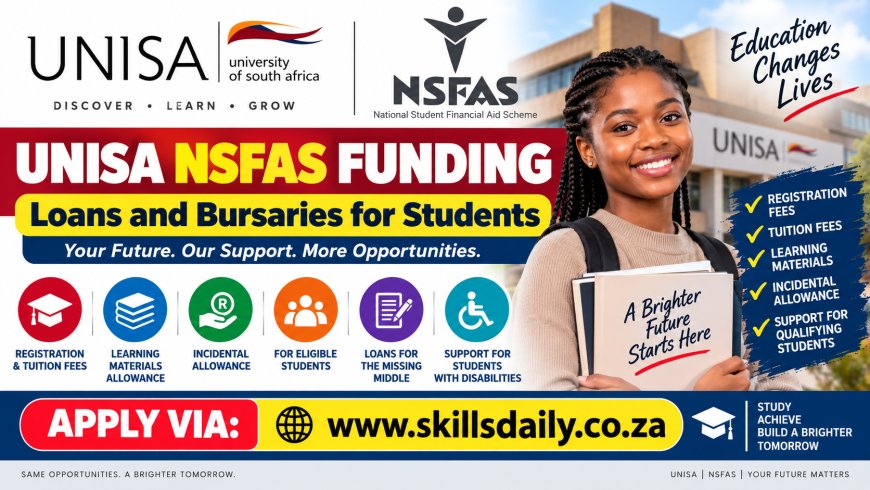
University of South Africa (UNISA) NSFAS Funding: Loans and Bursaries for Students
For many South African students, financial support can make the difference between starting a qualification and completing it. The National Student Financial Aid Scheme (NSFAS) provides financial assistance to eligible students studying at public universities and TVET colleges, including qualifying students at the University of South Africa (UNISA).
UNISA's Student Funding Directorate provides information and support around NSFAS funding, bursaries and loans, while NSFAS itself assesses applications and makes funding decisions.
Follow Skills Daily WhatsApp Channel
What Is NSFAS?
NSFAS is a government-funded financial aid scheme designed to provide financial support to eligible students who cannot afford the cost of higher education.
X20 University of Cape Town Free Online Courses: Learn New Skills and Advance Your Career
University of Pretoria Free Online Courses: Build Skills and Advance Your Career
Sedibeng TVET College Occupational Skills Development Programmes Funded by NSFAS
University of Johannesburg Free Courses: Build Valuable Skills
CETA-Funded Skills Development Occupational Programmes at Mopani TVET College
For qualifying UNISA students, NSFAS funding can assist with registration and tuition fees, as well as approved learning-material and incidental allowances.
Resolution Circle Work-Integrated Learning Programmes
Students should remember that UNISA does not approve or reject NSFAS applications. Applications and appeals are administered by NSFAS.
What Does NSFAS Cover at UNISA?
According to UNISA's current NSFAS information, qualifying funded students can receive support for:
Registration and Tuition Fees
Approved registration and tuition fees are paid directly to the institution.
Learning Materials
UNISA currently lists a Learning Material Allowance of:
- R660 per module for the first four modules
- R5,678 in total for students registered for five or more modules in an academic year.
Incidental Allowance
Qualifying students registered for 10 or more modules in an academic year can receive an incidental allowance of R316.70 per month for 10 months, according to UNISA's current NSFAS information.
Students should note that allowance amounts and funding rules can change, so applicants should always check the latest information from NSFAS and UNISA.
Who Qualifies for NSFAS Bursary Funding?
UNISA currently lists the following key requirements for NSFAS bursary funding:
- You must be a South African citizen or permanent resident.
- You must be registered or intending to register for an approved qualification at a public university or TVET college.
- Your combined gross household income must not exceed R350,000 per year.
- Returning students must meet applicable academic progression requirements, including the NSFAS N+ rule.
Meeting the basic requirements does not necessarily mean that funding will automatically be approved. NSFAS assesses applications and verifies the information provided.
What Is the NSFAS N+ Rule?
The N+ rule determines the maximum period for which NSFAS can fund a student's qualification.
The N represents the minimum number of years required to complete the qualification, while the additional year or years provide limited allowance for academic setbacks.
UNISA notes that every year in which a student is registered counts towards the N+ calculation, regardless of whether the student passed modules or whether NSFAS funded that particular year.
Students should therefore carefully manage their academic progress to avoid exceeding their funding period.
How to Apply for NSFAS
NSFAS applications are completed online through the official NSFAS website.
The general process is:
- Visit the official NSFAS website.
- Create or log into your myNSFAS profile.
- Complete your personal, academic and household information.
- Upload supporting documents requested by NSFAS.
- Submit your application before the applicable closing date.
- Regularly check your myNSFAS account for updates or requests for additional information.
Important: NSFAS applications are free. Students should never pay someone to submit an NSFAS application on their behalf.
NSFAS Applications for Students With Disabilities
Students with disabilities can also apply for NSFAS funding if they meet the relevant eligibility and academic requirements.
UNISA states that students with disabilities may need to submit:
- A medical report confirming the disability
- A completed NSFAS Disability Annexure
- Other supporting documents requested by NSFAS
Students should indicate their disability status when completing the online application.
Additional disability-related support, such as assistive devices or human support, may be considered where applicable.
What Is the NSFAS Loan?
NSFAS also has a separate student loan option aimed at the so-called "missing middle".
According to UNISA, the NSFAS loan is intended for students whose household income is above R350,000 but below R600,000 per year, subject to the applicable NSFAS loan requirements. For students living with disabilities, the income cap is R600,000 regardless of the lower threshold.
The loan can cover tuition and approved allowances, depending on the student's requirements and the applicable NSFAS rules.
Unlike a bursary, a loan is repayable. UNISA states that repayment begins once the student obtains employment, according to the applicable repayment agreement.
Who Can Apply for the NSFAS Loan?
The NSFAS loan may be considered for South African citizens or permanent residents whose household income falls within the applicable missing-middle range.
UNISA currently indicates that the loan can support eligible undergraduate and postgraduate qualifications, subject to the relevant NSFAS requirements. However, it does not fund a second undergraduate qualification for someone who has already completed an undergraduate qualification.
What Happens After Applying?
After submitting an application, NSFAS assesses the information provided.
For approved students, the process generally involves:
- NSFAS confirms eligibility.
- NSFAS communicates the funding decision to UNISA.
- UNISA processes the student's registration according to the funding confirmation.
- Approved tuition and registration costs are settled.
- Applicable student allowances are processed according to NSFAS rules.
Students can monitor their funding outcome through their myNSFAS portal.
What NSFAS Does Not Cover
NSFAS funding does not necessarily cover every cost appearing on a student's account.
UNISA specifically notes that NSFAS does not cover costs such as:
- Historical student debt
- Student card fees
- Library fines
- Fees for re-examinations or supplementary examinations
Students remain responsible for costs that are not covered under the applicable NSFAS funding rules.
What If Your NSFAS Application Is Rejected?
Students whose applications are rejected may be able to submit an appeal through their myNSFAS account, provided they meet the applicable appeal rules and deadlines.
UNISA's current information states that a 2026 NSFAS rejection can be appealed within 30 days of receiving the rejection notification. Supporting documentation should address the reason for the rejection.
Possible supporting evidence can include documentation relating to changed financial circumstances, serious illness or other circumstances that affected the student's situation.
Important Information for UNISA Students
Students should keep their personal and banking details up to date and regularly check their myNSFAS account.
UNISA also advises students to:
- Respond promptly to requests for documents.
- Maintain the required academic progress.
- Check their funding status regularly.
- Read the applicable NSFAS bursary or loan terms and conditions.
- Avoid unofficial individuals or websites claiming to process NSFAS applications.
The university warns students about scams and states that UNISA will not request payment or banking information through unofficial social-media channels.
NSFAS Funding and Registration
Students who have been confirmed as eligible for NSFAS funding should monitor their registration status carefully.
UNISA explains that once NSFAS confirms funding, the university receives the approved funding information and processes the student's registration. Students can then track their status through the appropriate systems.
For students who have been approved but encounter registration or qualification-related issues, it is important to contact UNISA through its official student-support channels.
Don't Confuse NSFAS Bursaries With Other Bursaries
NSFAS is not the only source of student funding available to UNISA students.
UNISA's Student Funding Directorate also provides information about other undergraduate and postgraduate bursaries, including the UNISA Merit Bursary, Department of Transport bursary, Hillensberg Trust bursary and SETA bursaries.
Some NSFAS-administered bursaries, such as Funza Lushaka, have their own eligibility requirements and application processes.
How to Apply
Students should apply directly through the official NSFAS platform rather than through third parties.
UNISA NSFAS Funding Information:
UNISA – NSFAS Loans and Bursaries
Official NSFAS website:
NSFAS – Official Website
FIND MORE FUNDING OPPORTUNITIES
Students looking for bursaries, NSFAS information, learnerships, internships and skills-development opportunities can also visit:
Final Thoughts
NSFAS funding can provide valuable financial assistance to eligible students pursuing approved qualifications at UNISA and other public higher-education institutions.
For qualifying students, the support can help cover registration, tuition, learning materials and applicable allowances. The NSFAS loan provides another potential funding route for eligible "missing middle" students whose household income falls above the bursary threshold but within the applicable loan range.
The most important step is to apply through the official NSFAS platform, submit accurate information, monitor your application and respond to requests for supporting documents.
X20 University of Cape Town Free Online Courses: Learn New Skills and Advance Your Career
University of Pretoria Free Online Courses: Build Skills and Advance Your Career
Sedibeng TVET College Occupational Skills Development Programmes Funded by NSFAS
University of Johannesburg Free Courses: Build Valuable Skills
CETA-Funded Skills Development Occupational Programmes at Mopani TVET College
Funding thresholds, allowance amounts, qualifying qualifications, application dates and other requirements can change. Always verify the latest information with NSFAS and UNISA before applying.
Vaal University of Technology NSFAS Funding: Financial Support for Students
What's Your Reaction?
 Like
3
Like
3
 Dislike
1
Dislike
1
 Love
0
Love
0
 Funny
0
Funny
0
 Angry
0
Angry
0
 Sad
0
Sad
0
 Wow
1
Wow
1