









GENERAL WORKER - Department of Agriculture and Rural Development
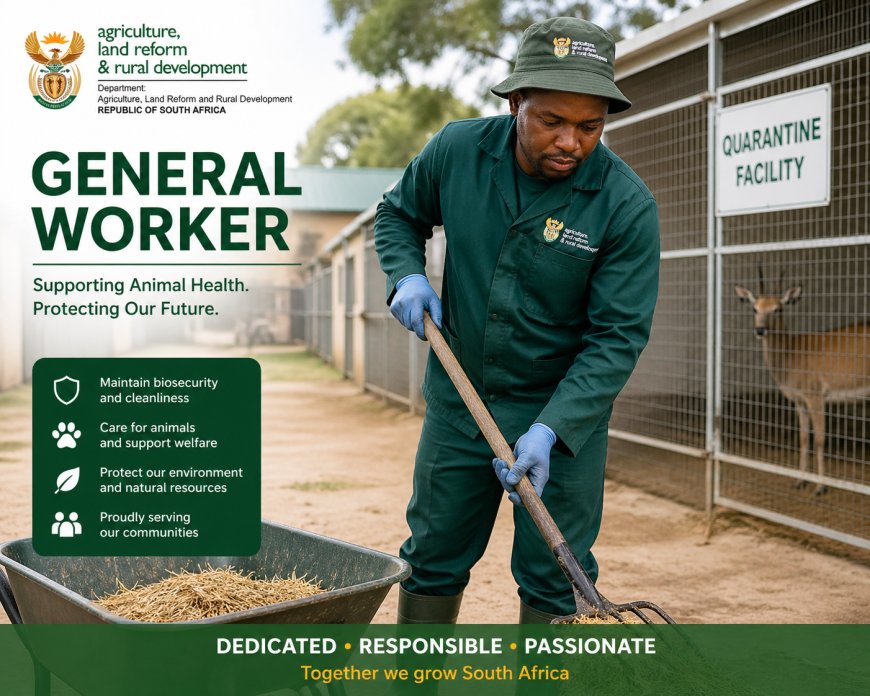
GENERAL WORKER (REF NO: 3/3/1/26/2026)
Directorate: Animal Health
Salary: R144 024 per annum (Level 02)
Centre: Mpumalanga – Skukuza
Minimum Requirements
- ABET or Basic Education qualification
- Relevant work experience, particularly with wild or large animals, will be an added advantage
Knowledge Requirements
- Public Service Regulations
- Procurement processes
- Public Finance Management Act (PFMA)
- Planning and organisational principles
- Workplace health and safety standards
- Understanding of cultural diversity
Required Skills
- Strong communication and interpersonal skills
- Planning and organisational ability
- Problem-solving and analytical thinking
- Good listening and interpretation skills
- Willingness to work extended hours when required
Key Responsibilities
- Maintain cleanliness of workstations and safely dispose of infectious materials
- Clean predator enclosures, stables, and bomas
- Remove bedding and wash floors and walls in animal holding areas
- Ensure strict adherence to biosecurity measures
- Operate the incinerator and record waste disposal activities
- Care for animals and birds in quarantine, reporting any issues promptly
- Provide appropriate feed to animals in quarantine
- Monitor and record daily animal health indicators
- Perform basic animal husbandry duties
- Maintain quarantine grounds, gardens, and perimeter fencing
- Cut grass, trim edges, and clear vegetation along fences
- Remove waste and foreign objects from premises
- Conduct daily inspections of electric fencing to ensure functionality
- Assist with clinical procedures, necropsies, and carcass incineration
- Support game capture operations and handle equipment
Enquiries
Dr Linmarie de Klerk-Lorist
Tel: (013) 735 9082
Application Process
Applications may be submitted:
- By hand during office hours at:
20 Steve Biko Street, Agriculture Place, Arcadia, Pretoria, 0002 - Or via email: GWrecruit26@nda.gov.za
Employment Equity
Preference will be given in line with EE targets:
Coloured, Indian, and White males; African, Coloured, and White females; and persons with disabilities.
The Role and Impact of the Department of Agriculture, Land Reform and Rural Development


The Department of Agriculture, Land Reform and Rural Development (DALRRD) is one of South Africa’s most important government institutions, responsible for ensuring food security, supporting farmers, managing land reform, and promoting sustainable rural development. Its work directly affects millions of people—particularly those living in rural communities—by creating opportunities, improving livelihoods, and strengthening the agricultural sector.
Mandate and Core Responsibilities
At its core, DALRRD focuses on three interconnected priorities: agriculture, land reform, and rural development.
1. Agriculture Development
The department works to:
- Support both commercial and emerging farmers
- Improve agricultural productivity and food supply
- Promote sustainable farming practices
- Provide extension services, training, and resources
Through these efforts, DALRRD plays a central role in maintaining South Africa’s food systems and ensuring that agricultural products remain accessible and affordable.
2. Land Reform and Redistribution
Land reform is a key part of South Africa’s transformation agenda. DALRRD is responsible for:
- Redistributing land to historically disadvantaged individuals
- Managing land restitution claims
- Securing land tenure for vulnerable communities
These initiatives aim to correct historical imbalances while enabling more South Africans to participate meaningfully in agriculture and land ownership.
3. Rural Development
Rural areas often face challenges such as unemployment, poverty, and limited infrastructure. DALRRD addresses these through:
- Developing rural infrastructure (roads, irrigation systems, facilities)
- Supporting small-scale and subsistence farmers
- Promoting local economic development initiatives
- Creating job opportunities in agriculture and related sectors
Supporting Animal Health and Biosecurity


A critical but often overlooked function of the department is animal health management. This includes:
- Monitoring and controlling animal diseases
- Running quarantine facilities
- Ensuring proper hygiene and biosecurity standards
- Supporting veterinary services
Roles such as general workers, animal health technicians, and veterinarians are essential in maintaining healthy livestock populations and protecting the agricultural economy.
Economic and Social Impact
Agriculture contributes significantly to South Africa’s GDP and employment. Through DALRRD’s programmes:
- Thousands of jobs are created annually
- Emerging farmers receive funding and training
- Rural economies are revitalised
- Food production is stabilised
The department also collaborates with private sector stakeholders, research institutions, and international partners to strengthen the sector.
Challenges and Opportunities
Despite its critical role, DALRRD faces several challenges:
- Climate change and drought conditions
- Limited resources in rural areas
- Land reform implementation complexities
- Skills gaps among new farmers
However, these challenges also present opportunities for innovation—such as climate-smart agriculture, digital farming technologies, and youth participation in agribusiness.
Conclusion
The Department of Agriculture, Land Reform and Rural Development is central to South Africa’s growth and sustainability. By balancing agricultural productivity, equitable land distribution, and rural upliftment, the department continues to shape a more inclusive and food-secure future.
Its work goes beyond farming—it is about empowering communities, protecting natural resources, and building a resilient nation.
Download The Poster Below
Files
What's Your Reaction?
 Like
2
Like
2
 Dislike
0
Dislike
0
 Love
0
Love
0
 Funny
0
Funny
0
 Angry
0
Angry
0
 Sad
0
Sad
0
 Wow
1
Wow
1