








General Stores Assistant - Water and Sanitation department
Job Summary
FOLLOW WHATSAPP CHANNEL FOR RECENT UPDATES
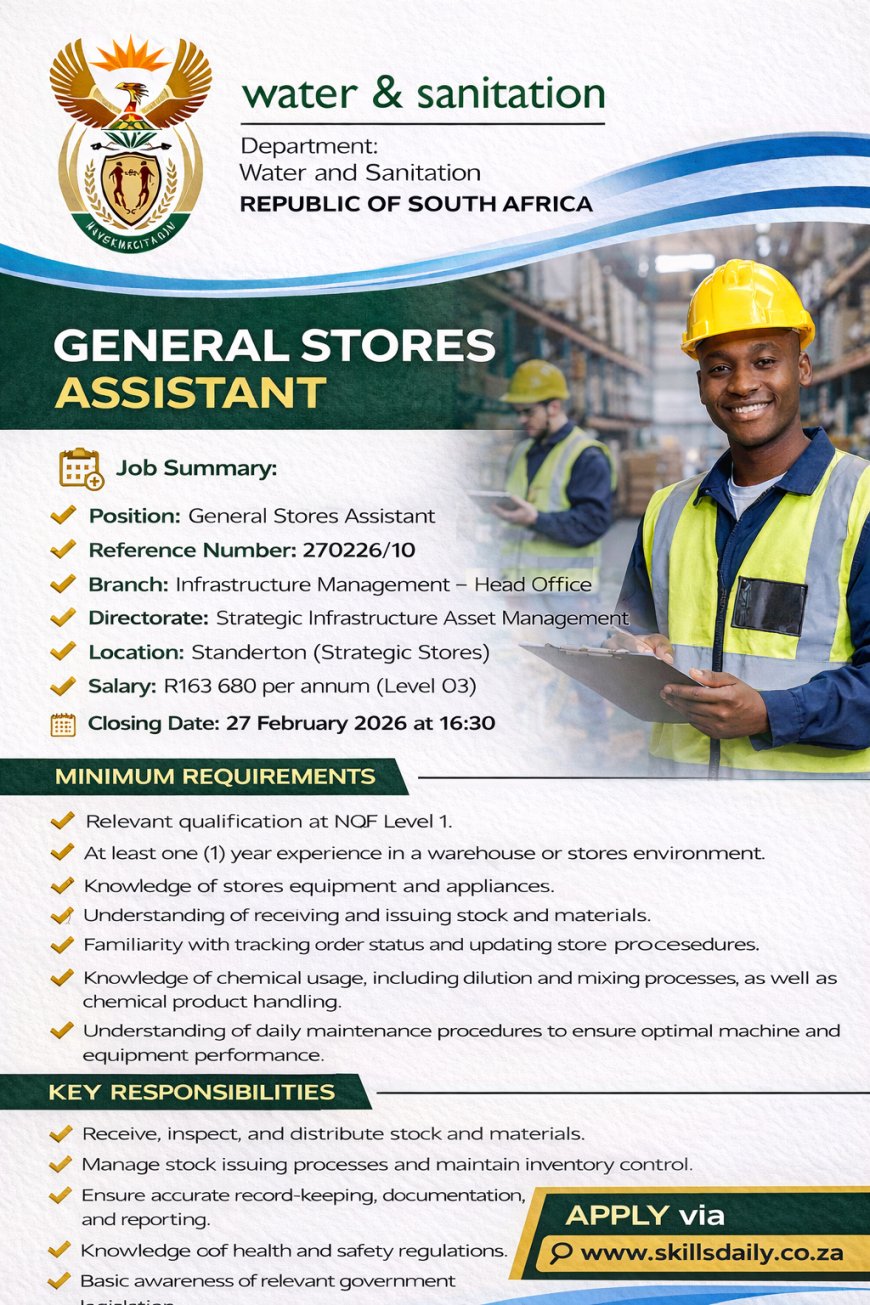
Position: General Stores Assistant
Reference Number: 270226/10
Branch: Infrastructure Management – Head Office
Directorate: Strategic Infrastructure Asset Management
Location (Centre): Standerton (Strategic Stores)
Salary: R163 680 per annum (Level 03)
Closing Date: 27 February 2026 at 16:30
Minimum Requirements
-
Relevant qualification at NQF Level 1.
-
At least one (1) year experience in a warehouse or stores environment.
-
Knowledge of stores equipment and appliances.
-
Understanding of receiving and issuing stock and materials.
-
Familiarity with tracking order status and updating store procedures.
-
Knowledge of chemical usage, including dilution and mixing processes, as well as chemical product handling.
-
Understanding of daily maintenance procedures to ensure optimal machine and equipment performance.
-
Basic knowledge of water utilisation and water resource strategies.
-
Knowledge of health and safety regulations and compliance.
-
Understanding of stores maintenance and issuing practices.
-
Basic awareness of relevant government legislation.
Key Responsibilities
-
Receive, inspect, and distribute stock and materials.
-
Manage stock issuing processes and maintain inventory control.
-
Ensure accurate record-keeping, documentation, and reporting.
-
Conduct physical verification of assets and compile disposal lists for strategic assets.
-
Maintain safe, clean, and well-organised storage areas.
-
Capture and allocate barcodes to assets on the system.
-
Coordinate stock logistics and provide operational support where required.
Department of Water and Sanitation (DWS): Safeguarding South Africa’s Most Precious Resource
Water is the lifeblood of any nation — essential for households, agriculture, industry, energy generation, and environmental sustainability. In South Africa, a country classified as water-scarce and highly vulnerable to climate variability, the Department of Water and Sanitation (DWS) plays a critical and strategic role in ensuring water security for both present and future generations.
Mandate and Core Responsibility
The Department of Water and Sanitation is responsible for managing and protecting South Africa’s water resources while ensuring equitable and sustainable access to water and sanitation services.
Its core mandate includes:
-
Developing and implementing national water policies and legislation
-
Regulating water use and allocation
-
Managing water infrastructure and bulk supply systems
-
Ensuring safe and dignified sanitation services
-
Protecting rivers, dams, wetlands, and groundwater systems
-
Supporting municipalities in delivering water and sanitation services
At its heart, the DWS must balance economic development, environmental protection, and social equity — a complex task in a country with uneven rainfall distribution and growing demand.
Water Security in a Water-Scarce Country
South Africa receives an average annual rainfall of about 450mm — well below the global average. This reality makes strategic water management not optional, but essential.
The DWS oversees:
-
Major dam systems and transfer schemes
-
National water resource planning
-
Bulk water infrastructure development
-
Drought response interventions
Projects such as inter-basin transfer schemes allow water to be moved from water-rich areas to high-demand regions like Gauteng, supporting both economic growth and domestic supply.
However, climate change has intensified droughts and floods, placing additional pressure on existing infrastructure and planning models. The Department must therefore integrate climate resilience into long-term water strategy.
Sanitation and Public Health
Sanitation is closely linked to dignity, public health, and economic development. The DWS works to eradicate unsafe sanitation practices and improve wastewater treatment infrastructure.
A key challenge has been:
-
Ageing municipal infrastructure
-
Poor wastewater treatment compliance
-
Pollution of rivers due to failing treatment works
Through regulatory tools and oversight programmes, the Department monitors municipal performance and drives compliance with national standards.
Legislative and Regulatory Framework
South Africa’s water governance is guided primarily by:
-
The National Water Act (1998)
-
The Water Services Act (1997)
These progressive pieces of legislation promote equitable access and recognise water as both a human right and an economic resource. The DWS is responsible for implementing and enforcing these frameworks, ensuring responsible water use licensing and environmental compliance.
Infrastructure Investment and Economic Development
Water infrastructure directly supports:
-
Agriculture and food security
-
Mining and industrial activity
-
Energy generation (including hydropower and cooling systems)
-
Urban expansion
The Department plays a central role in infrastructure planning and capital projects, often working with state-owned entities and private partners. Large-scale dam construction, rehabilitation projects, and bulk pipelines stimulate job creation and regional development.
Key Challenges Facing the Department
Despite its vital mandate, the DWS faces significant challenges:
-
Ageing and under-maintained infrastructure
-
Financial constraints at municipal level
-
Illegal water use and non-payment
-
Climate change and extreme weather events
-
Water pollution and declining river health
Addressing these challenges requires coordinated governance, strong financial management, technical expertise, and community cooperation.
The Future of Water Governance in South Africa
Looking ahead, the Department’s strategic priorities include:
-
Strengthening water-use monitoring systems
-
Enhancing infrastructure maintenance and refurbishment
-
Promoting water conservation and demand management
-
Expanding access to safe sanitation
-
Encouraging innovation in wastewater recycling and desalination
Water security is no longer just a service delivery issue — it is a national economic stability issue. As urbanisation increases and climate variability intensifies, integrated water resource management will be central to South Africa’s sustainability agenda.
Conclusion
The Department of Water and Sanitation stands at the forefront of one of South Africa’s most pressing national imperatives: securing water for people, the economy, and the environment.
Its work goes beyond pipes and dams — it shapes public health, economic resilience, environmental protection, and social equity. Strengthening the Department’s capacity and governance is therefore not only a policy priority, but a foundation for the country’s long-term prosperity.
CLICK HERE TO APPLY FOR THE JOB NOW
What's Your Reaction?
 Like
0
Like
0
 Dislike
0
Dislike
0
 Love
0
Love
0
 Funny
0
Funny
0
 Angry
0
Angry
0
 Sad
0
Sad
0
 Wow
0
Wow
0