








IEC Internships and Entry Level Employment 2026
Electoral Commission of South Africa (IEC): Safeguarding Democracy Through Free and Fair Elections
FOLLOW WHATSAPP CHANNEL FOR RECENT UPDATES
In any constitutional democracy, the legitimacy of government rests on the credibility of elections. In South Africa, that responsibility lies with the Electoral Commission of South Africa (IEC) — an independent constitutional institution entrusted with managing elections at national, provincial, and local levels.
Since the country’s first democratic elections in 1994, the IEC has been central to consolidating democratic governance and ensuring that the will of the people is expressed through transparent, free, and fair electoral processes.
Constitutional Mandate and Independence
The IEC was established in terms of Chapter 9 of the South African Constitution. As a Chapter 9 institution, it operates independently from government and is accountable to the National Assembly, not to the executive branch.
Its primary responsibilities include:
-
Managing national, provincial, and municipal elections
-
Ensuring elections are free and fair
-
Registering political parties
-
Maintaining and updating the national voters’ roll
-
Promoting voter education
This institutional independence is crucial. It ensures that electoral processes are not influenced by political interests, thereby strengthening public trust in democratic outcomes.
Building Electoral Integrity
One of the IEC’s greatest achievements has been the consistent delivery of credible elections in a politically diverse and highly contested environment.
Key pillars of electoral integrity include:
-
Transparent vote counting processes
-
Secure ballot handling and results systems
-
Observers and party agents monitoring polling stations
-
Clear dispute resolution mechanisms
The IEC’s systems are designed to withstand scrutiny from political parties, civil society, and international observers — reinforcing South Africa’s global reputation for credible elections.
Voter Registration and Participation
The voters’ roll is the backbone of electoral legitimacy. The IEC maintains a continuously updated national database of registered voters, ensuring that only eligible citizens can vote and that each vote counts once.
Through registration weekends, digital verification tools, and civic outreach campaigns, the Commission actively works to broaden participation, especially among youth voters who represent a significant demographic in South Africa.
However, declining voter turnout in recent years presents a challenge. Strengthening democratic participation requires ongoing civic education and public engagement beyond election cycles.
Managing Complex Elections
South Africa’s electoral system combines proportional representation with party-list voting. This requires careful logistical planning, including:
-
Printing and distributing millions of ballot papers
-
Deploying temporary staff and presiding officers
-
Managing thousands of voting stations across urban and rural areas
-
Capturing and auditing results efficiently
The IEC coordinates one of the largest peacetime logistical operations in the country during election periods — a task that demands both administrative precision and operational resilience.
Technology and Modernisation
The Commission has increasingly integrated technology into its processes:
-
Electronic voter roll verification at polling stations
-
Results capture systems to reduce delays
-
Online voter registration services
These innovations enhance transparency, efficiency, and accessibility. However, they also require robust cybersecurity measures to safeguard the integrity of electoral data.
Challenges Facing the IEC
While the institution has maintained a strong track record, it faces ongoing challenges:
-
Political contestation and misinformation
-
Budgetary constraints
-
Voter apathy and declining turnout
-
Public distrust in institutions
-
Ensuring accessibility for remote and marginalised communities
Addressing these issues requires not only administrative competence but also proactive public communication and trust-building.
Democracy Beyond Election Day
The IEC’s work extends beyond managing ballots. It plays a broader role in sustaining constitutional democracy by:
-
Educating citizens about their rights and responsibilities
-
Supporting political pluralism through party registration
-
Ensuring compliance with electoral legislation
-
Promoting ethical conduct during campaigns
Free and fair elections are not a single event — they are part of an ongoing democratic culture. The IEC’s responsibility is therefore both operational and symbolic: it embodies the principle that power in South Africa ultimately belongs to its people.
Conclusion
The Electoral Commission of South Africa stands as a cornerstone of the country’s democratic architecture. Through independence, transparency, and operational excellence, it has helped stabilise and legitimise political transitions for over three decades.
As South Africa navigates evolving political dynamics, technological change, and shifting public trust, the IEC’s role remains fundamental: to protect the integrity of the vote and ensure that democracy remains not just a constitutional promise, but a lived reality.
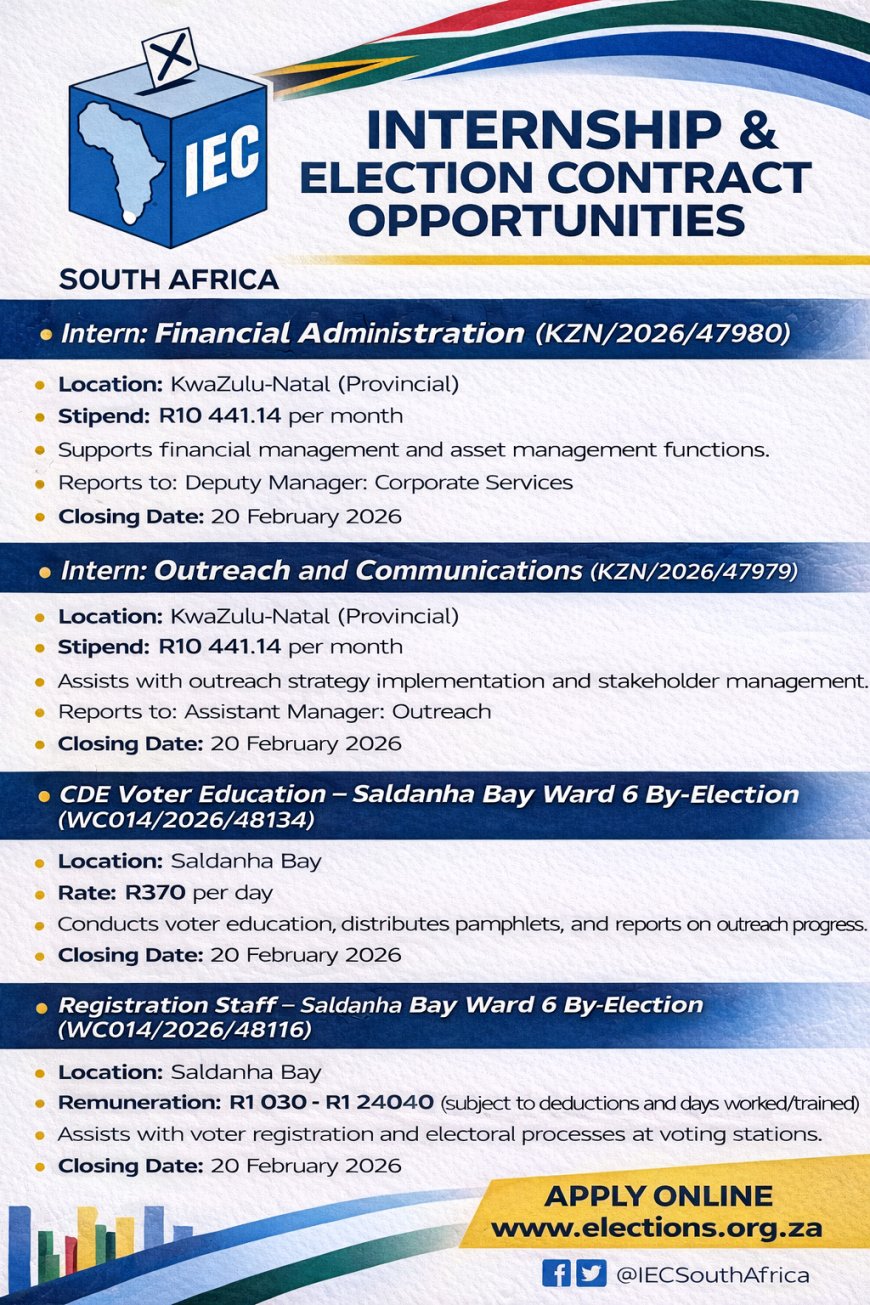
Intern: Financial Administration – KZN/2026/47980
Position Type: Internship
Location: KwaZulu-Natal (Provincial Office)
Monthly Stipend: R10 441.14
Published Date: Wednesday, 04 February 2026
Closing Date: Friday, 20 February 2026
Programme Overview
The Financial Administration Intern will support the effective coordination of financial management functions within the organisation.
The successful candidate will receive structured training and practical exposure in Asset Management, assisting with the efficient control and administration of asset-related processes across the organisation.
The internship may also provide exposure to additional areas within the Financial Management Unit to enhance overall professional development.
The Intern will report directly to the Deputy Manager: Corporate Services.
Intern: Outreach and Communications – KZN/2026/47979
Position Type: Internship
Location: KwaZulu-Natal (Provincial Office)
Monthly Stipend: R10 441.14 (inclusive remuneration package)
Published Date: Wednesday, 04 February 2026
Closing Date: Friday, 20 February 2026
Programme Overview
The Outreach and Communications Intern will support the development and implementation of the provincial Outreach Strategy and Action Plan.
The successful candidate will also gain practical experience in stakeholder engagement and relationship management, contributing to the organisation’s communication and public participation initiatives.
The Intern will report directly to the Assistant Manager: Outreach.
SALDANHA BAY WARD 6 BY-ELECTION
CDE: Voter Education – WC014/2026/48134
Position Type: Election Contract
Location: WC014 – Saldanha Bay
Field: Elections
Daily Rate: R370 per day
Published Date: Monday, 16 February 2026
Closing Date: Friday, 20 February 2026
Job Purpose
To conduct voter education initiatives within Ward 6, Saldanha Bay, by raising awareness and informing community members about the upcoming by-election.
Key responsibilities include distributing informational materials, educating residents on voting procedures, and reporting on outreach activities and progress achieved.
SALDANHA BAY WARD 6 BY-ELECTION
Registration Staff (Various Positions) – WC014/2026/48116
Position Type: Election Contract
Location: WC014 – Saldanha Bay
Field: Electoral Matters
Remuneration: Inclusive package ranging from R1 030 to R1 240 (subject to statutory deductions and number of days worked/trained)
Published Date: Monday, 16 February 2026
Closing Date: Friday, 20 February 2026
Job Purpose
To support and strengthen electoral democracy processes by assisting with the coordination and implementation of voter registration and related electoral programmes at voting station level.
Applicants should not have a prominent party-political profile.
All successful permanent appointees will be required to sign performance agreements.
Applicants holding foreign qualifications must ensure such qualifications are properly evaluated and verified in accordance with relevant requirements.
What's Your Reaction?
 Like
0
Like
0
 Dislike
1
Dislike
1
 Love
0
Love
0
 Funny
0
Funny
0
 Angry
1
Angry
1
 Sad
0
Sad
0
 Wow
1
Wow
1