






















Skills development learnerships at FoodBev Registration
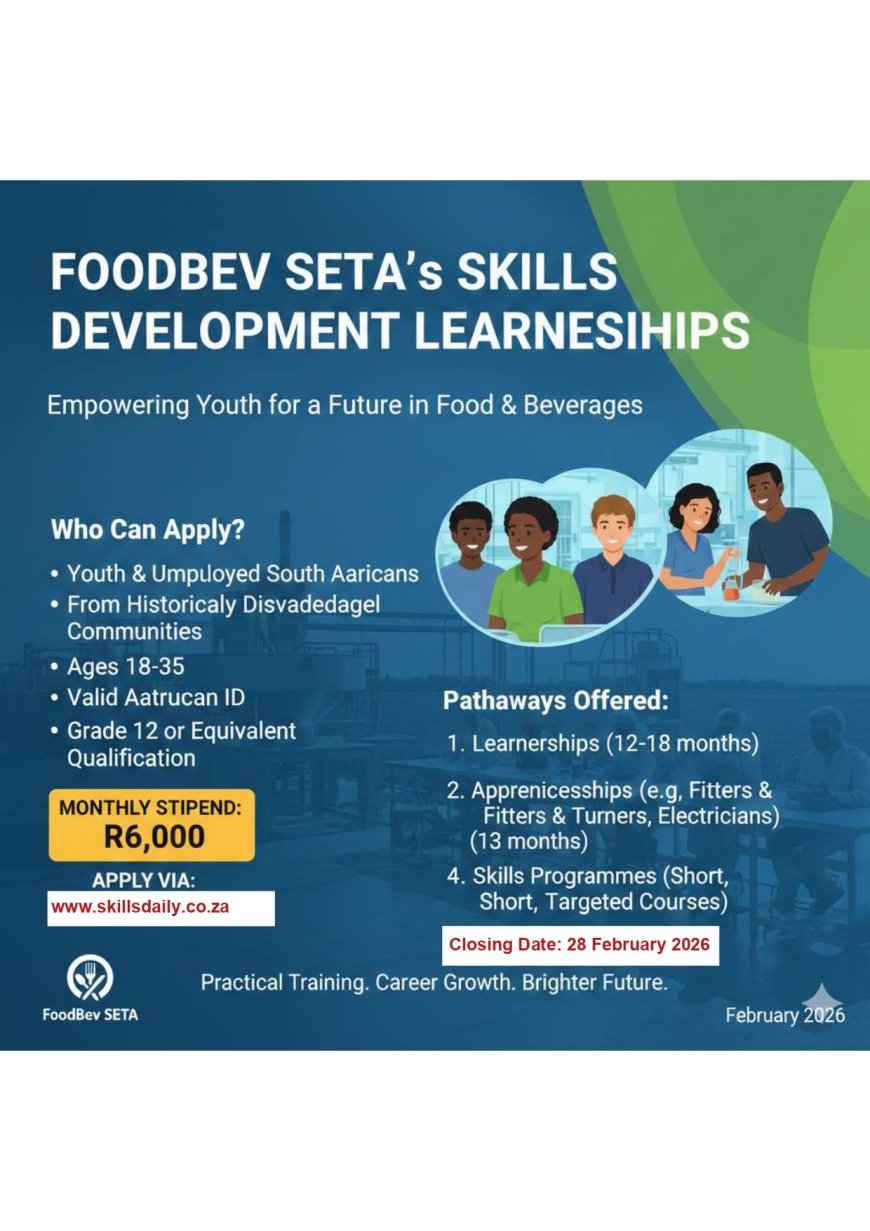
Fueling Growth and Opportunity: Skills Development Learnerships at FoodBev Manufacturing SETA
FOLLOW WHATSAPP CHANNEL FOR RECENT UPDATES
In South Africa, closing the skills gap and enhancing youth employability are essential for economic growth and social development. One organisation playing a significant role in this effort is the Food & Beverages Manufacturing Sector Education and Training Authority (FoodBev Manufacturing SETA) — a statutory body dedicated to developing skills within the food and beverages manufacturing sector.
FoodBev SETA focuses on equipping learners with industry-relevant knowledge and practical experience that meet the evolving demands of one of the country’s most vital economic sectors. Learnerships form a cornerstone of this approach, acting as structured pathways to nationally recognised qualifications and workplace readiness.
What Are Learnerships?
Learnerships are work-based learning programmes that blend classroom training with real-world workplace experience to deliver nationally recognised qualifications registered on the National Qualifications Framework (NQF). These programmes are developed in partnership with industry and are directly linked to specific occupations or job roles in the food and beverages manufacturing field.
Unlike purely academic courses, learnerships emphasise practical skills, industry standards and workplace competencies — making participants more attractive to employers while empowering them with relevant, hands-on experience.
Who Can Benefit?
FoodBev SETA’s learnerships are especially designed to support:
-
Youth and unemployed South Africans, particularly those from historically disadvantaged communities
-
Individuals with Grade 12 or equivalent qualifications seeking practical training and a career pathway
-
People who want to enter or grow in the food and beverages manufacturing industry
Participants typically earn a monthly stipend, attend formal training sessions, and complete workplace assessments as part of their learnership journey.
These programmes not only build vocational competence, but also instil soft skills like teamwork, communication and problem-solving — traits that are highly valued in any workplace.
What Do the Programmes Look Like?
FoodBev SETA supports a variety of structured learning options including:
1. Learnerships
These lead to NQF-registered qualifications (Level 2–5) in areas such as food processing, beverage production, quality assurance and other manufacturing-related fields. Learnerships typically run for 12–18 months and blend theory with practical training, including supervised workplace experience. Participants often receive a monthly stipend during the programme.
2. Apprenticeships
In tandem with learnerships, FoodBev SETA also supports apprenticeships in scarce trades like fitters and turners, electricians, millwrights and air-conditioning technicians — roles critical to the wider manufacturing environment. These combine formal instruction with on-the-job learning and may lead to artisan certification.
3. Internships and Work Integrated Learning (WIL)
For TVET college and university students, FoodBev SETA’s work integrated learning placements provide vital industry exposure that bridges academic knowledge with real workplace application. WIL opportunities are typically shorter (1–3 months) but improve employability and help learners build professional networks.
4. Skills Programmes
Short, targeted courses leading to partial NQF credits — often focusing on specific practical competencies like food safety, production support or technical operations.
Why Learnerships Matter
1. Employment Pathways
Learnerships increase participants’ chances of gaining sustainable jobs by giving them real applied experience alongside a recognised qualification — a combination that many employers look for when hiring.
2. National Skills Development
By aligning training to industry needs, FoodBev SETA’s programmes help address South Africa’s national skills shortages, especially in key manufacturing roles that are hard to fill.
3. Stipends and Financial Support
While learning, many participants receive a stipend (often between R2,500 and R4,000 per month for learnerships and internships) to support them financially during the training period — helping learners focus on skill acquisition rather than financial strain.
4. Soft Skills and Career Readiness
Aside from technical competencies, learners also develop transferable skills — such as communication, time management and teamwork — which bolster their confidence and adaptability in the workplace.
Building a Skilled Future
FoodBev Manufacturing SETA’s learnerships and related programmes sit at the heart of a strategic effort to equip South Africans with meaningful qualifications and work experience that make them competitive in the job market. By bridging the gap between education and employment, these initiatives contribute to economic growth, industry sustainability and individual empowerment.
Whether you’re a school leaver, graduate or someone seeking a new career direction, FoodBev SETA’s learnerships offer a structured, supported pathway to build your skills, enhance your prospects and become part of the future of South Africa’s food and beverage manufacturing industry.

What's Your Reaction?
 Like
50
Like
50
 Dislike
4
Dislike
4
 Love
37
Love
37
 Funny
2
Funny
2
 Angry
5
Angry
5
 Sad
15
Sad
15
 Wow
19
Wow
19