










MICTSETA Work Integrated Learning Programmes
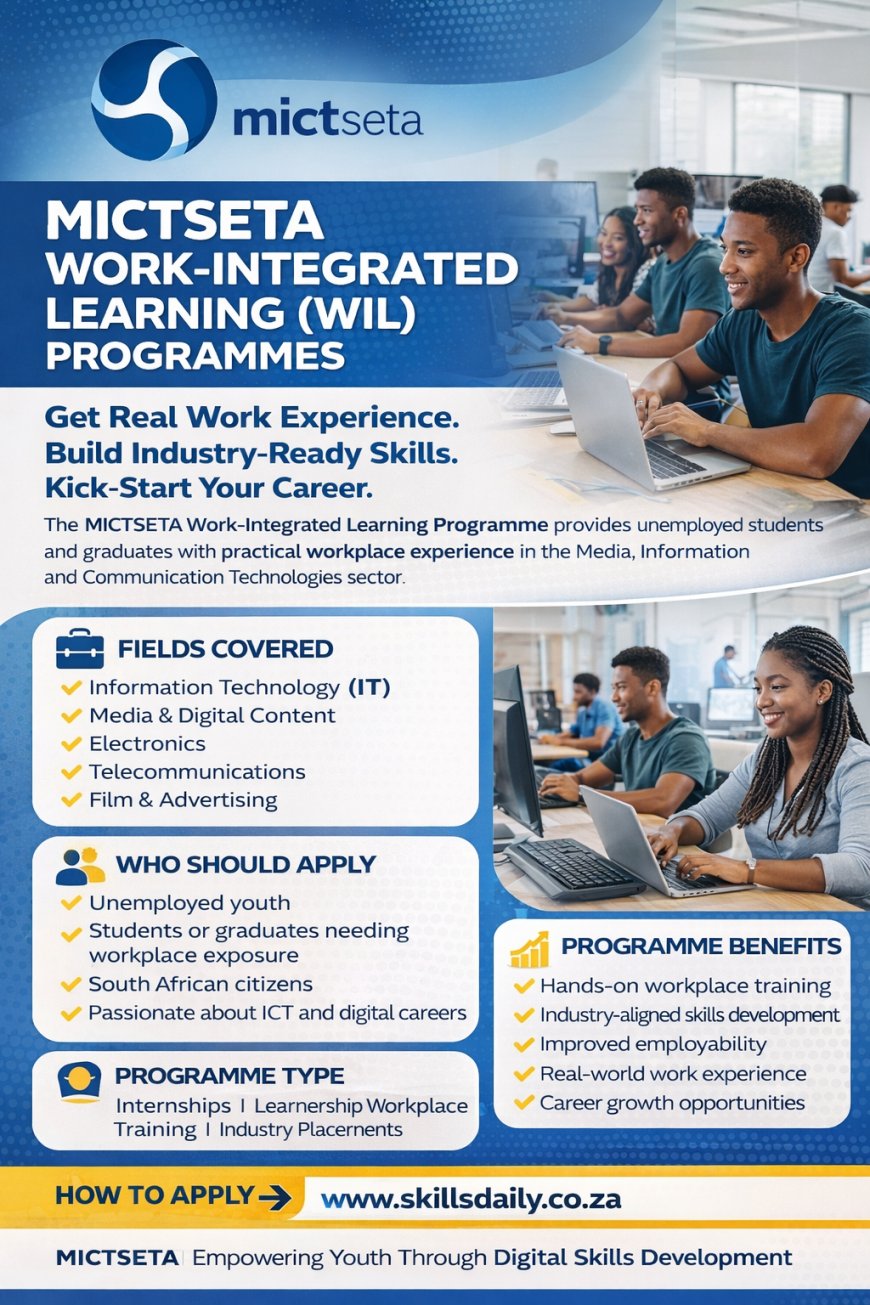
MICT SETA — what they do and how their Work-Integrated Learning (WIL) programmes work
FOLLOW WHATSAPP CHANNEL FOR RECENT UPDATES
The Media, Information and Communication Technologies Sector Education and Training Authority (MICT SETA) is the South African SETA responsible for skills development across five interrelated sub-sectors: Advertising; Film & Electronic Media; Electronics; Information Technology; and Telecommunications. Its core mandate is to translate national skills policy into industry-relevant training, quality assurance, and workplace experience that improve employability and support sector growth.
Below is a practical, detailed guide to MICT SETA’s Work-Integrated Learning (WIL) activity — what WIL is, how MICT SETA runs WIL programmes, who benefits, how employers and learners take part, evidence of impact, common challenges, and practical tips for success.
What is Work-Integrated Learning (WIL)?
Work-Integrated Learning is an educational strategy that intentionally connects classroom or theoretical knowledge with authentic workplace practice. WIL can include internships, workplace placements for TVET and university students, learnership practical components, short industry-specific programmes, and vendor-specific training where students apply learned skills under supervision in real work contexts. These programmes are designed with clear learning outcomes, assessment criteria and workplace supervision so that students graduate with both qualification credits and practical experience.
How MICT SETA structures and supports WIL
MICT SETA delivers and funds WIL in several complementary ways:
-
Funding and grants: MICT SETA opens discretionary grant windows and funds employer partners and training providers to host WIL placements that address sector skills needs. These grants often prioritise sector-strategic skills and vulnerable groups (youth, women, people with disabilities).
-
Programme types: WIL activity is delivered through internships, the workplace components of learnerships, bursary-linked placements, and short, vendor-specific programmes tailored to tech employers. MICT SETA’s website lists learnerships, internships, skills programmes and WIL as core offerings.
-
Quality assurance & alignment: Programmes are linked to qualifications on the NQF where relevant, and MICT SETA performs quality assurance to ensure workplace learning maps to learning outcomes and assessment criteria. This is important for recognition and certification.
-
Partnerships: MICT SETA works with employers, TVET colleges, universities, training providers and government departments to place students, co-fund placements and design industry-aligned curricula. Recent multi-year strategic partnerships (e.g., for 4IR/digital skills) demonstrate the SETA’s emphasis on future skills.
Who benefits and why WIL matters
-
Students / graduates: gain workplace readiness, industry contacts, and evidence of practical competence that strengthen CVs and job prospects.
-
Employers: develop job-ready talent, build a skills pipeline, and influence the design of training to meet business needs.
-
The sector & economy: WIL reduces the gap between theoretical qualifications and workplace expectations, supporting job creation and the digital/electronic media ecosystem in SA.
Typical WIL programme features (as run/supported by MICT SETA)
-
Duration: varies (short vendor courses, 3–12 month internships, learnership practicals matching qualification length).
-
Stipends & learner support: MICT SETA-funded learnerships typically include a monthly stipend for learners (official guidance has referenced amounts such as R2,500 for funded learnerships — check current programme adverts for exact figures).
-
Assessment: workplace supervisors and accredited assessors evaluate performance against outcomes; successful completion may contribute to qualification completion and certification.
-
Inclusivity: many WIL calls encourage female candidates, youth, and people with disabilities, and some placements are reserved or prioritised for historically disadvantaged groups.
Example: a live WIL story
MICT SETA has publicised successful WIL partnerships — for example, a collaboration that placed TVET students with a tech-marketing company where students completed supervised internships and gained hands-on experience in digital marketing workflows and campaign tools. These case studies illustrate how WIL placements can quickly transform classroom learning into practical workplace competence.
How employers can partner with MICT SETA for WIL
-
Watch discretionary grant windows: MICT SETA advertises funding windows for projects that include WIL placements; apply when calls are open.
-
Design a structured placement: define learning outcomes, mentorship/supervision plans, assessment criteria and workplace tasks linked to learning outcomes.
-
Agree on learner support: stipends, travel or accommodation support (if applicable), induction, and health & safety training.
-
Register with the SETA if required: for some funded programmes employers must be registered stakeholders or submit compliance documentation.
-
Provide mentorship and assessment: allocate experienced staff as workplace mentors and coordinate with assessors/training providers for final evaluations.
How students and TVET/university learners can access WIL
-
Apply to college/university WIL offices: many institutions coordinate workplace placements and have agreements with MICT SETA or its employer partners.
-
Monitor MICT SETA and partner adverts: MICT SETA posts internships, learnerships, bursary placements and WIL opportunities on its website and in discretionary grant announcements.
-
Prepare a workplace CV & portfolio: highlight projects, relevant practical skills (software, hardware, media work), and readiness to learn.
-
Be proactive in placements: employers value learners who demonstrate initiative, punctuality, and a willingness to apply theory in practical situations.
Impact, limitations and common challenges
Impact: WIL helps reduce the school-to-work transition friction by producing more work-ready graduates and supplying industry with entry-level talent. MICT SETA’s strategic plans and funded projects target digital and 4IR skills to align sector needs with national development priorities.
Challenges:
-
Funding constraints and limited employer capacity to absorb many learners at once.
-
Ensuring consistent, high-quality supervision and assessment across many host sites.
-
Geographic gaps — placements often cluster in urban hubs while rural learners struggle to access opportunities.
-
Keeping curricula and practical training aligned with rapidly changing technologies (4IR).
Recommendations & practical tips
For policymakers and MICT SETA
-
Continue strategic partnerships with industry to co-fund scalable WIL and focus on 4IR skill pipelines.
For employers
-
Build structured mentorship plans, factor in modest stipends, and partner with colleges/universities to share assessment duties. Consider remote/hybrid placement models where possible to widen geographic access.
For students
-
Treat WIL like a real job: be punctual, document your tasks, ask for feedback, and collect evidence of work (deliverables, code, media reels) to show future employers.
Where to find more information & next steps
-
Visit MICT SETA’s official site for current WIL listings, learnerships, internships, bursary calls and discretionary grant adverts.
-
For national policy context and post-school education planning, consult the Department of Higher Education & Training.
Short checklist (for a student about to start WIL)
-
Read your placement’s learning outcomes.
-
Agree on tasks and weekly supervision schedule.
-
Clarify stipend, hours, and reporting lines.
-
Keep a logbook and evidence of completed tasks.
-
Ask for a written reference or certificate upon completion.
Final note
MICT SETA’s Work-Integrated Learning programmes are a key bridge between study and work in South Africa’s media, IT, electronics and telecoms sectors. When well-designed and funded, WIL placements build practical competence, open career pathways, and help the sector keep pace with technological change — but they perform best when employers, training providers, the SETA and learners all commit to clear outcomes, good supervision and continuous improvement.
Enquiries please contact: Zimasa.Simayi@mict.org.za
What's Your Reaction?
 Like
3
Like
3
 Dislike
0
Dislike
0
 Love
1
Love
1
 Funny
0
Funny
0
 Angry
0
Angry
0
 Sad
0
Sad
0
 Wow
0
Wow
0